

By late afternoon, the founder’s screen looks like a crime scene of modern work. Email tabs multiply. Slack channels flicker with red badges. WhatsApp, LinkedIn, and calendar alerts pile up at the edge of vision. Each application suggests urgency; together, they blur into fatigue. The real risk is not that nothing gets done, but that the single message capable of changing a quarter remains buried between travel confirmations and status updates. Kinso enters here, not as another place to check, but as an attempt to reorganize this entire landscape of communication into something that can be read, understood, and acted on.
Kinso is a young company that treats conversations as its raw material. It was founded by brothers Frank and Jacques Greeff, who experienced this overload firsthand while scaling their previous business. Instead of building a new messaging platform, they set out to build an AI-powered “brain” for the tools people already use: email, chat, social messaging, calendars, and contact lists. Their distinct position in the industry comes from a simple focus: find a way to turn scattered, easily forgotten messages into timely, actionable insight for people whose decisions carry disproportionate weight.
The Shift From Communication To Overload
In many companies, communication volume has outpaced any reasonable human capacity to manage it. Email remains the backbone of formal interaction, but internal coordination has moved to channels like Slack and Teams. Clients and candidates prefer messaging apps and social platforms, while calendars and notes hold crucial context that rarely appears anywhere else. Each service does its job well in isolation. Together, they create a fragmented record of what is happening and why.
This fragmentation changes the nature of work. Leaders still attend meetings, make calls, and write documents, but the connective tissue of their role now lives in threads dispersed across systems. A hiring decision might involve a résumé in email, comments in chat, a brief exchange on LinkedIn, and a calendar note from a prior conversation. A customer decision might depend on support tickets, private messages, and a hastily typed “we should talk” in a direct channel. Without a way to view these fragments as one continuous story, people are forced to reconstruct context repeatedly.
The result is not just annoyance; it is a measurable distortion of focus. Time is spent searching, re-reading, and cross-checking rather than deciding. Anxiety rises as leaders sense that unseen conversations exist somewhere in the background, shaping outcomes without their awareness. In this environment, simply adding more filters or muting more notifications cannot resolve the core issue. The problem is not that there is too much to see; it is that what needs to be seen is not clearly distinguished from everything else.
Kinso’s founders recognized this gap as a structural weakness, not a personal failing. They concluded that no amount of “better habits” could solve what amounted to an architectural mismatch between how tools store information and how humans think about work. The only sustainable improvement would come from changing the way conversations are organized and surfaced.
Kinso’s “Conversation Graph” View Of Work
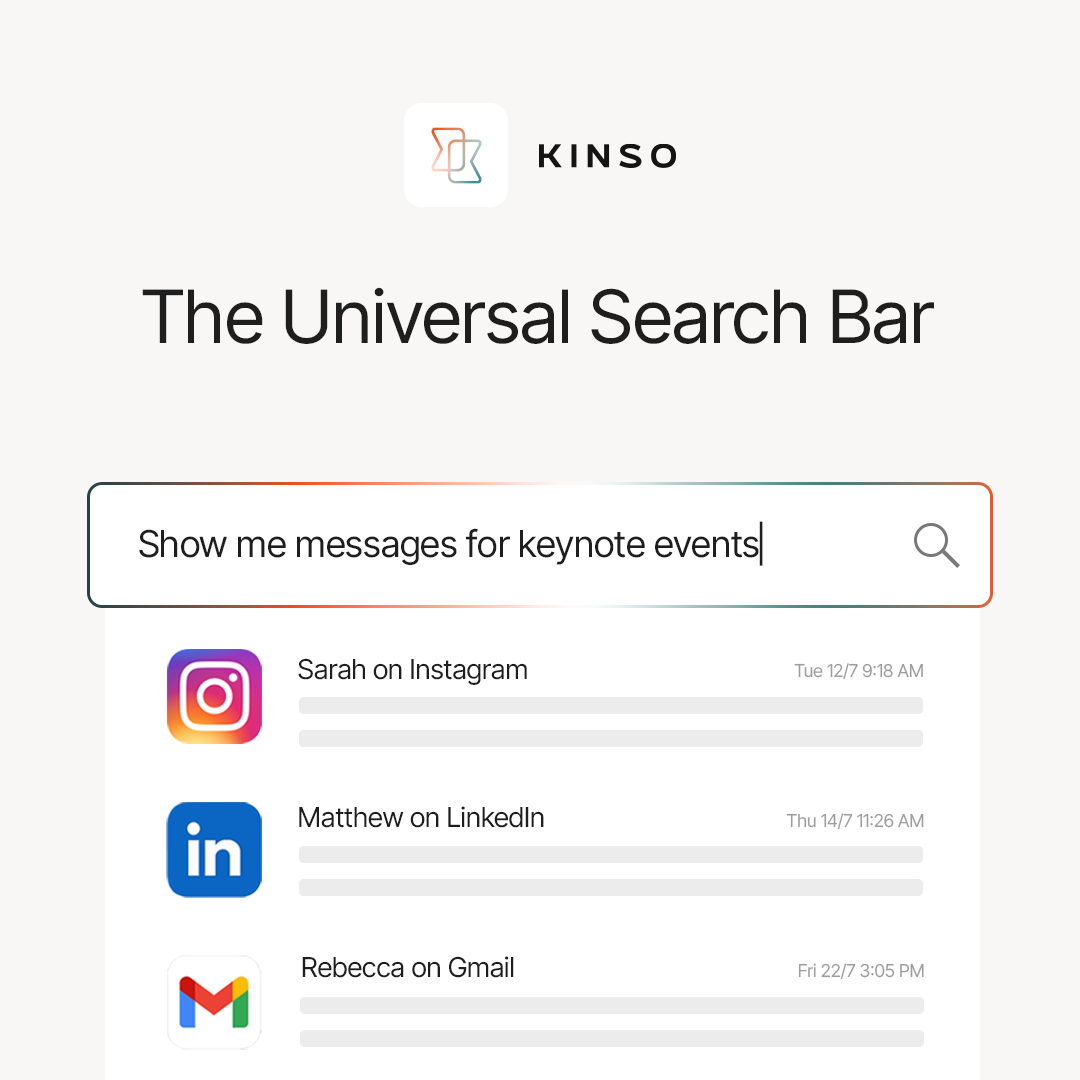
Kinso’s core idea is to treat every message, appointment, and contact as part of a unified graph rather than as items in separate lists. The product connects to existing tools and ingests their contents into a single, flexible data structure. Instead of preserving the boundaries between email, chat, and social messages, it emphasizes relationships: who communicated with whom, about what, and in what sequence.
When a user opens Kinso, they do not see six inboxes lined up side by side. They see a ranked set of threads that reflect this underlying graph. A brief note from a major customer might sit above a detailed internal update, because prior patterns suggest that such notes have preceded important decisions or risks. A message about hiring in one channel might be linked to a candidate conversation in another, presenting the situation as a coherent whole rather than as isolated pings.
This approach allows Kinso to function as a kind of narrative engine. Instead of asking the user to remember where a discussion happened, the system can show the evolution of a topic across platforms and time. If someone asks about the status of an agreement, Kinso can surface the original proposal, the intermediate debates, and the latest comments without the user having to jump between tools or recall exact keywords. The focus moves from retrieval to comprehension.
On top of this graph, Kinso introduces prioritization. Rather than ordering everything by recency, it builds what the team calls an “opportunity stack”: a view that ranks threads according to their likely impact on outcomes such as revenue, fundraising, hiring, and relationship health. This ranking draws on the structure of the graph and on observed behavior. Over time, the system learns which types of messages its users consistently treat as meaningful and which can safely fall into the background.
For the people Kinso targets—founders, investors, senior operators—this reframing is central. Their days are not defined by the volume of communication but by a few critical decisions. An insight buried in an old thread can matter more than 20 new notifications. By elevating such signals, Kinso aims to convert the inbox from a log of what has arrived into a tool that suggests what should happen next.
Insights Instead Of Fragments
The phrase “rewriting the future of work” can sound grandiose, but in Kinso’s case it points to a specific shift: from a world where communication is primarily a record to one where it is treated as live data. In the older model, email archives and chat histories are places to look back. In the model Kinso is building, those archives are continuously scanned for emerging patterns.
This scanning happens in several ways. The system can identify themes—such as hiring, fundraising, renewals, or partnership discussions—and show how they are developing across people and time. It can highlight when a topic resurfaces after a long pause, drawing attention to situations that might otherwise drift. It can detect when multiple signals converge around a person or account, such as increased contact volume, repeated delays, or subtle changes in tone. None of these indicators constitutes certainty, but together they create a richer set of prompts for human judgment.
By presenting these patterns in the same interface as day-to-day messages, Kinso attempts to bridge the gap between analytics and lived experience. The insights are not abstract dashboards removed from context; they are directly tied to the conversations users already recognize. A founder does not need to interpret a new chart; they need to see that three different threads, across three platforms, all point to the same underlying issue.
This design reflects a particular philosophy about AI in the workplace. Kinso does not try to replace human decision-making or to automate entire workflows. Instead, it aims to expand the “informational surface area” available at the moment of choice. The system can suggest that a conversation deserves attention, or that a pattern resembles a past success or failure. The decision remains with the person whose relationships and responsibilities are at stake.
Kinso’s situation within the industry is shaped by this stance. Many products in the productivity and AI space promise acceleration: faster drafting, faster scheduling, faster task completion. Kinso promises something subtler: a reordering of attention and an elevation of hidden context. It is less concerned with how quickly people can respond, and more with whether they are responding to the right things.
A Different Measure Of Progress
If Kinso succeeds, its impact may not appear in the usual metrics of productivity software. The number of messages sent might remain the same. The count of tasks completed might not change dramatically. The difference would show up in places that are harder to track: fewer deals lost because a quiet warning went unnoticed; fewer hiring efforts delayed by forgotten leads; fewer relationships allowed to cool because subtle signals were missed.
From the company’s perspective, progress can be measured by the shrinking gap between what users know in theory and what they can act on in practice. When a founder says, at the end of a week, that nothing important feels unresolved or mysteriously absent, that is a kind of success. When they can trace a major decision back through a clear line of conversations, rather than a hazy recollection of “somewhere in Slack,” that is another.
The future of work will likely include more tools, more channels, and more automation, not fewer. Kinso’s profile is defined by its decision to accept that complexity and then concentrate on a modest but deep question: how to turn buried emails and scattered messages into insight that arrives while there is still time to use it. In doing so, it shifts the conversation about productivity away from doing more and toward seeing more clearly.
For the founders and operators who live inside overflowing inboxes, that shift can feel quietly radical. The goal is not a pristine, empty interface, but a working day in which judgment is spent on real choices rather than on the effort of remembering what those choices are. In that sense, Kinso is less rewriting the future of work than insisting that the present one be fully readable.