

By 9 a.m., the workday already feels out of control. A founder has checked email on a laptop, Slack on a second screen, WhatsApp on a phone, LinkedIn on a browser tab, and calendar alerts buzzing in the background. Each window contains something potentially important; none offers a clear sense of what matters most. The who, what, when, where, why, and how of the job are scattered across apps, leaving a dull anxiety that something crucial is being missed. That tension is the environment in which Kinso, an Australian startup, has decided to plant its flag. Kinso sits at the intersection of AI and productivity, a space defined less by scarcity of information than by scarcity of attention. The company was founded by brothers Frank and Jacques Greeff after they built and sold a real‑estate technology business, an experience that left them with a simple but uncomfortable realization: critical deals often turned on small, messy, easily overlooked moments in communication. A casual message about timing, a half‑promised introduction, a one‑line concern from a key account—any of these could shape outcomes, yet all were buried in the same digital clutter as everything else.
Their new venture is built around a blunt premise: the modern workday is not failing because people lack tools, but because those tools fragment context and force humans to act as their own routers. Kinso’s answer is a universal inbox that tries to understand not just what was said, but how conversations relate across channels and priorities.
The real cost of digital clutter
Digital clutter is often described as a cosmetic problem: too many notifications, too many tabs, an inbox with four‑digit unread counts. For the kinds of users Kinso targets, the cost runs deeper. Founders, investors, revenue leaders, and chiefs of staff operate in roles where a small number of conversations carry massive weight. A missed investor reply can stall a round. A neglected message from a major customer can threaten a renewal. A forgotten hiring lead can slow an entire team.
The structure of modern communication makes those misses more likely. Email remains the default for formal exchanges, but internal collaboration has migrated to tools like Slack and Teams. Customers and candidates increasingly prefer messaging apps and social DMs. Calendars hold critical notes that never appear elsewhere. Each system is optimized for its own flow; none is designed to show how the pieces fit together. The result is a hidden tax on decision‑makers: constant context switching, repeated searches, and the mental load of wondering what has slipped.
Traditional productivity fixes offer limited relief. Turning off notifications can reduce interruptions, but it does nothing to reconstruct history across platforms. Labeling messages and building rules can help inside a single client, but not across six. Even the idea of “inbox zero” starts to feel misaligned when the real question is not how many messages are unread, but which ones matter and whether they will be seen in time.
Kinso’s founders treat digital clutter as a systems problem rather than a personal failing. In their view, too much of the burden of integration has been pushed onto individuals: humans are expected to remember where each conversation happened, what was decided, and what connects to what. The company’s premise is that software should do more of that work.
One inbox, many channels, shared context
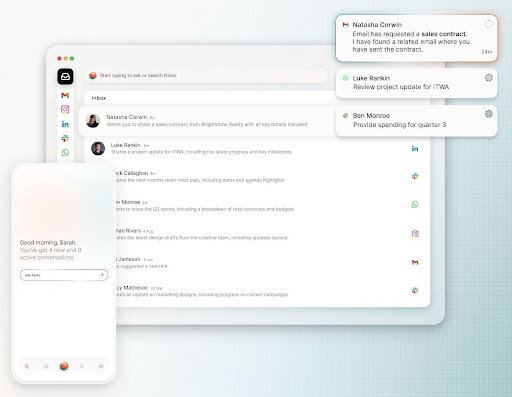
Kinso’s core product is a unified inbox that connects to email, chat, social messaging, calendars, and contacts, then presents them in one workspace. On the surface, this sounds similar to earlier “all‑in‑one” tools. The difference lies in what happens after the connections are made.
Instead of simply sorting messages by time and source, Kinso treats them as nodes in a relationship graph. A question about contract status in email is linked to a file sent in a chat channel, which might connect to a calendar event where the same customer was discussed. A brief mention of “hiring a senior engineer” lives alongside a LinkedIn thread with a promising candidate and an internal discussion about headcount. The system’s job is to recognize that these fragments belong to the same story.
This graph‑based view changes what an inbox can be. Rather than a series of isolated threads, it becomes a set of overlapping narratives about deals, hires, partnerships, and internal decisions. When a user clicks into a conversation, the relevant history from other apps can surface automatically. The question shifts from “Where did they send that?” to “What is everything we already know about this?”—a subtle change that eliminates dozens of small searches and guesswork.
Above that, Kinso adds a ranking layer. Instead of ordering everything by recency, the product creates what it calls an “opportunity stack”: a prioritized list of threads that appear to have the highest potential impact. Messages likely connected to revenue, fundraising, hiring, or relationship risk are pulled toward the top; routine notifications sink. The clutter does not vanish, but it no longer competes on equal footing with the few conversations that really matter.
Redefining “getting hours back”
The phrase “get back hours every day” has become a cliché in productivity marketing, often reduced to claims about shaving seconds off repeated tasks. Kinso’s framing is more structural. The company focuses less on micro‑efficiencies and more on recovering blocks of time and attention that are currently lost to confusion and reconstruction.
One way it does this is by reducing what might be called “search tax.” When everything related to a given person, account, or topic can be pulled into view quickly, the need to remember exact keywords or jump between apps diminishes. Before a meeting, a user can call up key prior exchanges, open loops, and relevant documents without manually piecing them together. During a busy day, they can scan a ranked list that highlights fragile opportunities and looming risks rather than being pulled into whichever app shouted loudest most recently. Another way is by changing the default starting point of the day. In a typical workflow, people open email or chat and process messages in the order they arrived, mixing low‑impact noise with high‑impact work. Kinso encourages a different ritual: start with the opportunity stack, handle the few threads that will most shape the week, then move outward. That shift does not remove tasks, but it reshapes the emotional texture of the day. Instead of feeling behind on everything, users can be “ahead” on the things that matter most.
The company’s distinct position in its industry comes from aligning this behavior change with the realities of high‑leverage roles. Their users are not looking for another to‑do list or a more colorful email client. They are looking for a way to ensure that their finite judgment is spent where it counts. In that sense, eliminating digital clutter is less about aesthetic minimalism and more about shrinking the gap between responsibility and visibility.
A narrower, deeper kind of productivity
Kinso’s approach also reflects a shift in how AI is being applied to knowledge work. Recent years have seen a rush of tools focused on generating content: writing emails, drafting documents, producing slides. Kinso belongs to a quieter, emerging category that uses AI primarily for organization and triage. Its intelligence is mostly invisible, working behind the scenes to connect, rank, and resurface rather than to speak in the user’s voice.
This emphasis on background intelligence shapes both the product and the narrative around it. The app does not ask users to become prompt engineers or to trust a chatbot with crucial replies by default. Instead, it aims to make the existing flow of messages more truthful about what is at stake. When users do lean on automation—for instance, to draft a follow‑up or an introduction—the goal is not to send more messages, but to close the loop on the ones that would otherwise linger unresolved.
In a crowded productivity landscape, that narrower focus constitutes Kinso’s distinct situation. Many competitors promise to help people “do more” by adding steps, dashboards, or metrics. Kinso’s value proposition is almost the opposite: do less of the wrong work, with less worry about what you forgot. It is a tool built for a world where volume is a given, but missed moments are what keep people up at night.
The vision is modest in one sense and ambitious in another. Kinso does not claim it can quiet the wider communications ecosystem. Message volume will likely continue rising, new apps will continue to appear, and humans will continue to overcommit. What the company does claim is that it can narrow the class of mistakes that feel unforgivable: the late reply to the one investor who mattered, the unnoticed signal from the biggest customer, the opportunity that died because nobody connected three related threads.
If that claim holds, the “hours” it gives back will not appear as empty slots on a calendar. They will appear as days that feel less scattered, weeks that end with fewer nagging doubts, and decisions made with more complete context. In the story Kinso is trying to tell, eliminating digital clutter is ultimately less about tidiness and more about sovereignty over attention: the ability, finally, to choose what to look at first, and to trust that the things that matter will not be left buried in the noise.