

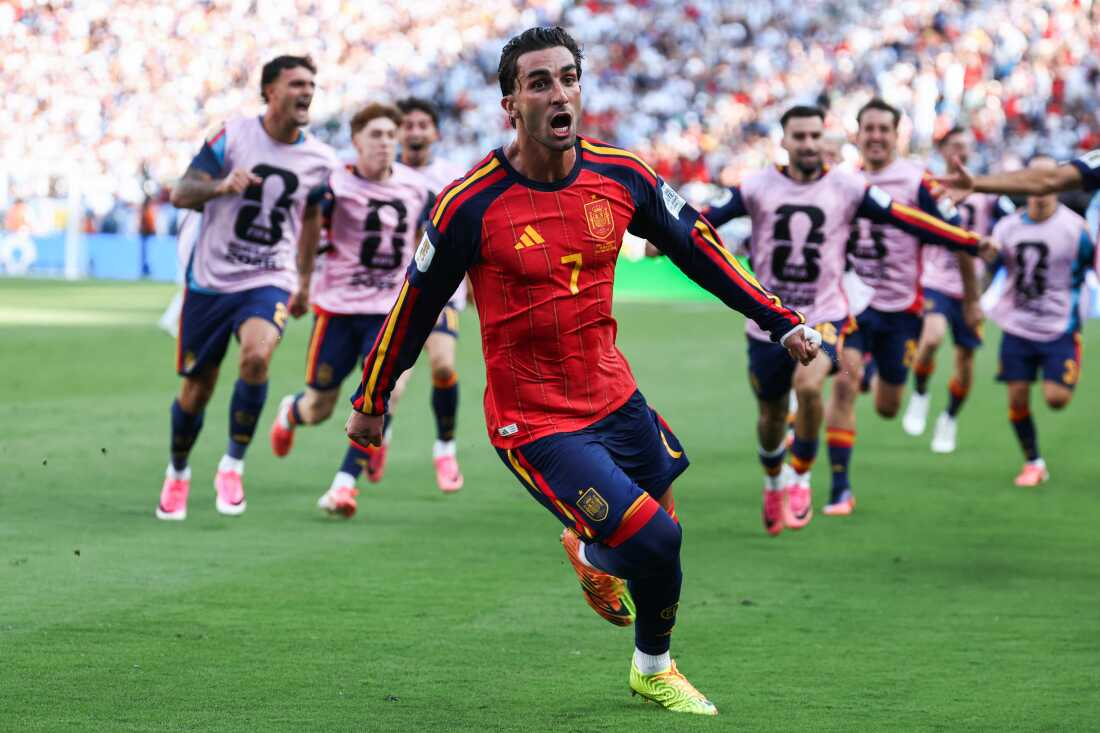

For 105 minutes on Sunday night, the most lucrative sporting event ever staged could not produce a goal in its final match. Then Ferran Torres, a substitute who had been on the field for less than half an hour, met a headed pass from Nico Williams and hammered it into the roof of Argentina’s net at MetLife Stadium in East Rutherford, New Jersey. Spain won 1-0 after extra time, claied its second World Cup and its first since 2010, and ended a 39-day tournament that world soccer’s governing body expects to be the most profitable in its history.
The goal arrived 39 seconds into the second period of extra time, according to Yahoo Sports, and it settled more than a trophy. FIFA had wagered its flagship product on radical expansion, growing the field from 32 teams to 48, spreading 104 matches across the United States, Mexico and Canada, and pricing the event for the American corporate market. The bet returned a projected $8.9 billion from the tournament alone, according to SportsPro, the largest share of the roughly $13 billion FIFA forecasts for its 2023 to 2026 commercial cycle. That cycle figure is about 72 percent higher than the $7.57 billion FIFA earned in the four years ending with Qatar 2022, according to FIFA reporting analyzed by Mappr.
The final itself, though, spent two hours testing whether the product could match the price tag.
The product nearly failed the spectacle
Spain dominated to a degree rarely seen in a World Cup final. The Europeans took 20 shots and generated 1.94 expected goals to Argentina’s 0.20, per Yahoo Sports, and forced Argentina goalkeeper Emiliano Martínez into 11 saves, a record for a World Cup final. Argentina did not register an attempt on goal until the 117th minute, when Lionel Messi, playing what may be his last World Cup match at 39, had a shot blocked, according to ESPN.
The reigning champions had been reduced to ten men in stoppage time at the end of the 90 minutes, when referee Slavko Vinčić showed Enzo Fernández a second yellow card for a foul on Spain defender Pau Cubarsí. Argentina, chasing a feat no nation had managed since Brazil in 1962, back-to-back World Cups, retreated into pure resistance and nearly dragged the game to penalties before Torres struck.
Spain’s win completed a run that borders on the mechanical. La Roja entered the final on a 37-match unbeaten streak in regulation, matching Italy’s all-time record, according to CBS News, and coach Luis de la Fuente became the oldest manager to win a World Cup, per Yahoo Sports. Paul Tenorio of The Athletic told CBS News before kickoff:
“Spain came into the tournament as the favorite.”
The favorite delivered, with a squad whose core, including 19-year-old Lamine Yamal and teenage defender Cubarsí, will still be in its prime when the next two World Cups arrive.
The math behind the 48-team bet
Expansion was always a revenue decision dressed in the language of inclusion. More teams meant more matches, more broadcast windows and more sponsor inventory. Sponsorship income for the cycle grew roughly 55 percent from 2022 to about $2.8 billion, according to MarketScale, with American brands such as Visa, Coca-Cola and Home Depot buying heavily into a tournament played largely in their home market.
The players saw some of the upside. Prize money reached a record $871 million, with every one of the 48 qualified nations guaranteed at least $12.5 million, according to SportsPro. Staging costs rose too. This was the most expensive World Cup ever to run, with a FIFA budget of $3.76 billion, per the same SportsPro analysis.
The uncomfortable part of the ledger sits with the host cities. Business Standard, citing a ProPublica and Houston Chronicle review of host-city contracts, reported that almost all organizing costs fell on the cities themselves while their ability to collect offsetting revenue was constrained, since FIFA does not share ticket income with them. Add the backlash over dynamic ticket pricing and a pre-tournament report from Common Goal and Football For Future finding that ten of the 16 stadiums exceeded safe-play heat thresholds, covered by SportsPro, and the record revenue arrives with genuine questions attached. A governing body registered as a Swiss non-profit just banked its biggest payday while the municipalities that hosted it absorbed the operational bill. That tension will not disappear before the 2030 edition.
What Spain’s win means for the next cycle
Soccer’s economics now reward exactly what Spain has built, a production line of young, marketable talent tied to a national style that wins. Yamal is already among the most commercially valuable athletes on earth, and Sunday put a World Cup winner’s medal behind the endorsements. Argentina, by contrast, closes an era. Messi’s generation won everything available to it, and the 0.20 expected goals it mustered on Sunday reads like a full stop.
FIFA, for its part, exceeded its own Qatar forecasts by more than $1 billion last cycle, according to Business Standard, and analysts quoted by IBTimes expect the final 2026 tally to climb once post-tournament accounting closes. The 2030 World Cup, spread across three continents for the tournament’s centenary, will test whether the number can keep rising. On Sunday’s evidence, the game’s owners will keep betting that it can, and Spain’s teenagers will still be there to collect.