

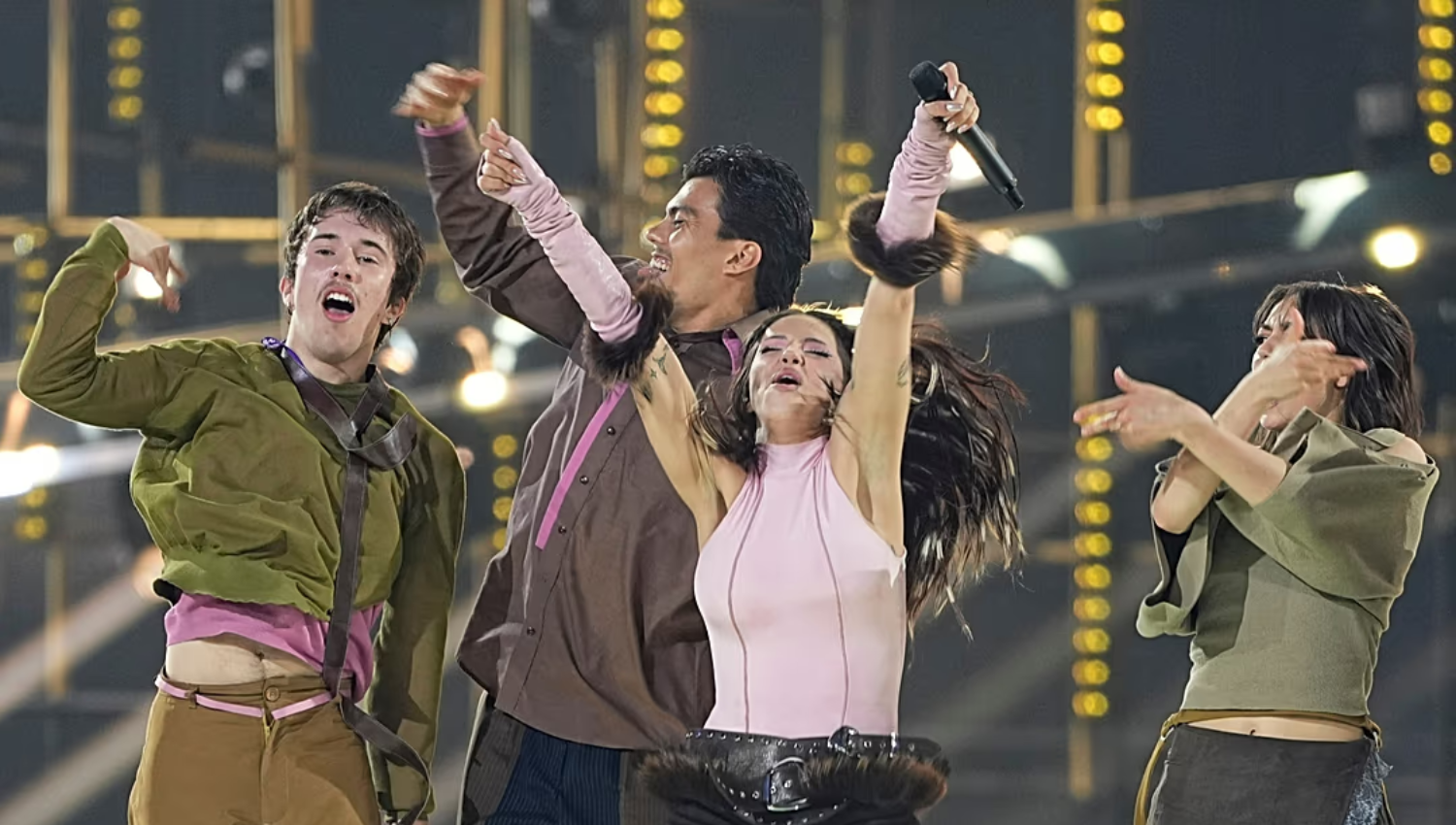
Bulgaria has won the 70th Eurovision Song Contest, with Dara’s party anthem “Bangaranga” taking the title in Vienna after a finish that stayed unresolved until the last set of votes was read out.
Dara saw off 24 rivals at Saturday’s grand final in the Austrian capital. The song’s relentless beat and drilled choreography landed with viewers and national juries alike. It is the first Eurovision win in Bulgaria’s history, and the country will host the 71st edition next year.
One of the better-known pop acts working in the Balkans today and a mentor on The Voice Bulgaria, Dara had not been counted among the favourites. She first drew attention on X Factor Bulgaria and has since built a reputation for high-octane club tracks and considerable stage presence.
A result decided at the last moment
For much of the vote it looked as though Israel’s Noam Bettan would win. He was met with loud cheers and some booing while performing “Michelle,” a rock ballad sung in Hebrew, French and English, and pro-Palestinian chants were audible on the broadcast during parts of the performance.
The juries had put Bulgaria on 204 points, with Australia and Denmark level on 165. Austria and the United Kingdom finished that stage on a single point each. The public vote then reshaped the board, leaving Bulgaria on 516, Israel on 343 and Romania on 296.
Romania’s Alexandra Căpitănescu took third with the pointedly titled rock song “Choke Me.” Australian singer Delta Goodrem finished fourth with the polished midtempo ballad “Eclipse,” and Italian crooner Sal Da Vinci came fifth with “Per Sempre Sì,” or “Forever Yes.” Finland’s pairing of pop singer Pete Parkkonen and classical violinist Linda Lampenius, who had led the betting markets going into the final, ended sixth on 279 points.
The UK’s Look Mum No Computer finished bottom with “Eins, Zwei, Drei,” collecting one point from the juries and none from the public.
Eurovision historian Dean Vuletic said upsets are part of the format’s character.
“Eurovision has never really been a contest for big stars. It’s largely been a contest for underdogs,” he said. “People like to see the underdog on stage. They like to the artist-in-the-making on stage or an artist from a smaller, poorer country on stage.”
Pop and politics
Security was heavy around the arena and across Vienna, with demonstrations over Israel’s participation and the war in Gaza breaking out before the show. Five countries stayed away entirely.
Hundreds marched near the venue ahead of Saturday’s final, some carrying placards reading “Block Eurovision.” Pro-Palestinian groups held an outdoor concert on Friday under the banner “No stage for genocide.”
“It is our duty as artists to stand up and raise our voices,” Austrian musician Patrick Bongola told the crowd at that alternative event. Another activist argued that Israel’s presence at a peaceful music event should not be treated as normal while the war continued. Protesters said organisers could not claim neutrality while Israel remained in the contest.
Spain was the most consequential absence, and as a member of the ‘Big 5’ it underwrites much of the contest’s finances — leaving the EBU with both a budget hole and a sizeable missing audience. Prime Minister Pedro Sánchez restated the boycott on the day of the final, saying silence was not an option and that Spain stood on the right side of history. Ireland, the Netherlands, Iceland and Slovenia also withdrew.
Organisers had already adjusted the rules before this edition, following accusations of political interference and televote manipulation. Israel had been accused by critics and broadcasters of campaigning aggressively to shape the previous year’s public vote. For 2026, the maximum number of televotes per payment method was cut, and professional juries returned to the semi-finals.
After months of argument and internal conflict, the 70th year of the world’s oldest and largest song contest may be remembered as one of its most divisive.
Three minutes to make it count
Each act had three minutes to win the room over, and Dara used all of them. “Bangaranga” is the kind of pop record Eurovision rewards, built around a line that functions as an instruction: “Surrender to the blinding lights. No one’s gonna sleep tonight. Welcome to the riot.”
She was among several women who commanded the stage. Germany’s Sarah Engels delivered a soulful ballad, Poland’s Alicja brought a gospel-inflected R&B number, Ukraine’s Leléka held the arena with a note that ran on for close to half a minute, and Sweden’s Felicia and France’s Monroe went in opposite directions with techno-pop and opera-pop respectively.