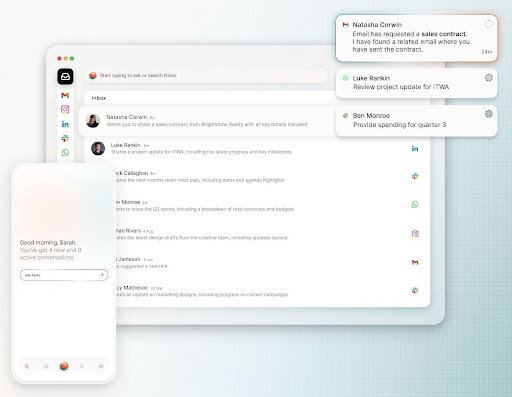


Many founders and operators work across a patchwork of communication channels: email, Slack, WhatsApp, LinkedIn, Teams, Instagram, Facebook, TikTok, and others. Conversations that once lived primarily in a single inbox are now dispersed, making it harder to understand priorities, track commitments, and maintain relationships consistently. Kinso presents itself as an AI-powered universal inbox designed to bring these conversations into one searchable view, helping users focus on high-impact work rather than managing app-by-app chaos.
The core idea is straightforward but consequential: for high-performing operators, the most important unit of work is no longer the individual message or even a single inbox, but rather the relationship, deal, or initiative that spans multiple platforms. Kinso focuses on rebuilding a coherent picture across all of them, aligning communication tooling with how founders, executives, and investors actually work today.
Fragmented Communication as a Structural Problem
Communication volume is not just high; it is continuously compounding. Investor updates, hiring conversations, customer issues, and partnership discussions often move back and forth between channels over time. A single candidate might be sourced via LinkedIn, interviewed via email and calendar tools, messaged in Slack or Teams once onboarded, and checked in with via WhatsApp. Each touchpoint is meaningful, but they are split across systems that do not naturally speak to each other.
This fragmentation makes it challenging to answer routine questions quickly. A founder trying to understand the current state of a fundraising process may need to check email for initial outreach, Slack for internal feedback, WhatsApp for quick clarifications, and LinkedIn for follow-up. The same is true for a revenue leader tracking a multi-threaded enterprise deal or a chief of staff trying to ensure no commitment to a key stakeholder has been forgotten. Without a unified view, a significant amount of energy is spent simply reconstructing context.
Traditional inboxes and collaboration tools often operate within narrow scopes. Advanced email clients streamline triage, provide faster tools, and offer smart categorization—right within emails. These tools assume that the most important communication remains inside their respective boundaries. Kinso starts by rejecting that assumption, asserting that modern work is cross-channel by default and that serious operators need a system built for that reality.
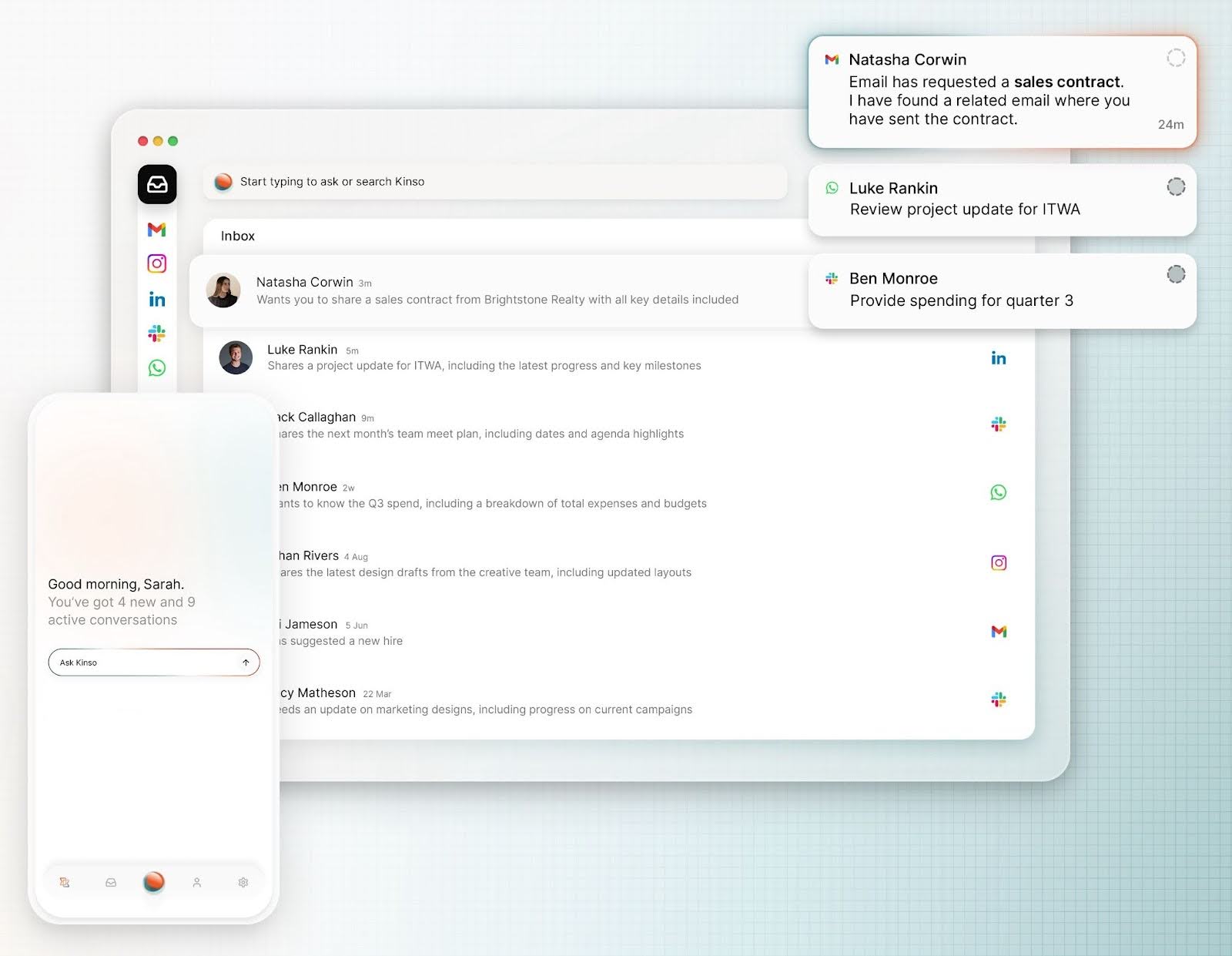
Kinso’s universal inbox aggregates messages from various sources, including email, Slack, WhatsApp, LinkedIn, Instagram, and others, into a single interface. The goal is not simply to mirror each inbox, but to provide users with a consolidated view where they can see who has reached out, what was said, and what still requires a response, regardless of origin. This channel-agnostic approach is central to its claim to help users “regain control” of workflow, because control in this context begins with accurate visibility.
One Universal Inbox as an Operational Tool
Kinso organizes its value around consolidation, prioritization, and recall. Consolidation is the foundation. Instead of toggling among tabs and mobile apps, users see a single feed that reflects the totality of their connected communication. For high-performing operators, this reduces the friction of checking “one more place” in case something critical comes in.
Prioritization is where the product aims to distinguish itself. Rather than presenting a neutral, chronological list, Kinso ranks threads by likely impact and urgency. It is designed to “rank your highest-impact threads, rescue buried asks, and turn scattered chats into a single deal-flow dashboard.” Messages tied to live deals, hiring needs, or key relationships can be surfaced above lower-stakes notifications, helping users decide where to invest their limited attention.
Recall is supported through what Kinso describes as “second-brain” memory. Instead of a classic keyword search constrained to one system, users can issue plain-English queries that span their entire connected history. The system aims to reconstruct context across email, messaging, and social threads, so that users do not need to remember which app or exact phrasing was used. For busy founders and executives, this reduces the cognitive load of remembering where information lives and how to retrieve it.
Pre-meeting preparation is another operational use case. Kinso can surface pre-meeting “flash cards” that highlight key personal details, open loops, and priorities for a given contact based on past conversations across platforms. Rather than manually scanning multiple apps before a call, users receive a concise, curated briefing. This supports more consistent and informed interactions, especially in schedules packed with back-to-back meetings where context-switching is frequent and costly.
From Communication Log to Opportunity and Risk Map
Kinso’s positioning also reflects a broader shift in how productivity is measured in its segment. For founders and senior operators, the key risk is not simply “too many messages”; it is the cost of missed opportunities and slow responses in a capital-efficient environment. Kinso’s design is oriented toward making those points of leverage easier to spot and act on.
“Next-step intelligence” is one expression of this orientation. Kinso can detect requests in messages—for example, “Need a senior iOS engineer”—and then scan the user’s broader network to suggest potential connectors and even pre-draft an introduction. Similarly, it can draft follow-ups that maintain the user’s tone and context, helping sustain momentum without requiring the user to originate every response from scratch. This functionality is particularly relevant for revenue owners, BD leads, and investors who maintain value through warm introductions and timely responses.
The “contextual opportunity engine” describes how Kinso interprets the unified message stream as a map of themes and signals. The system builds a live mind-map around topics such as hiring, fundraising, and partnerships, and flags warm intros, deal signals, and relationship risks that might otherwise be missed in the noise. Instead of treating messages as static records, the engine treats them as indicators of opportunities and vulnerabilities that deserve attention. This reframes the universal inbox as an analytical tool, not only an organizational one.
A Distinct Role in a Crowded Landscape
Kinso operates in a crowded landscape that includes email accelerators, collaboration platforms, CRMs, and social inbox tools. What differentiates it is the combination of audience focus and product scope. The product is explicitly “for high-performing business operators”: time-starved founders and C-suite operators juggling investor updates, team communications, and customer DMs; revenue and BD leaders trading on rapid response and introductions; solo capital allocators and angel investors managing hundreds of fragmented deal threads; chiefs of staff and strategic EAs tasked with shielding executives from noise while never dropping a ball.
For these users, minor communication failures can escalate into significant strategic setbacks. A universal inbox that simply merges feeds is not enough; it must help users see which conversations are the most consequential, what has been promised, and what needs to happen next. Kinso’s roadmap—channel-agnostic ingestion, opportunity-ranking tuned to founder KPIs, network-aware actions, and an emphasis on privacy—reflects that focus. It is less a general-purpose messaging tool and more a specialized workspace built around the realities of relationship-led growth and capital-efficient execution.
In this sense, “regaining control of workflow” is not about returning to a simpler time with fewer channels. It is about having a single, reliable place where all of the complexity can be viewed, queried, and acted on coherently. Kinso argues that, for contemporary founders and operators, control means seeing across every channel at once, understanding which threads truly matter, and being able to move decisively on them. Its distinct role in the industry is to make that kind of visibility and responsiveness possible from one universal inbox, rather than leaving it to individual operators to piece together manually day after day.