
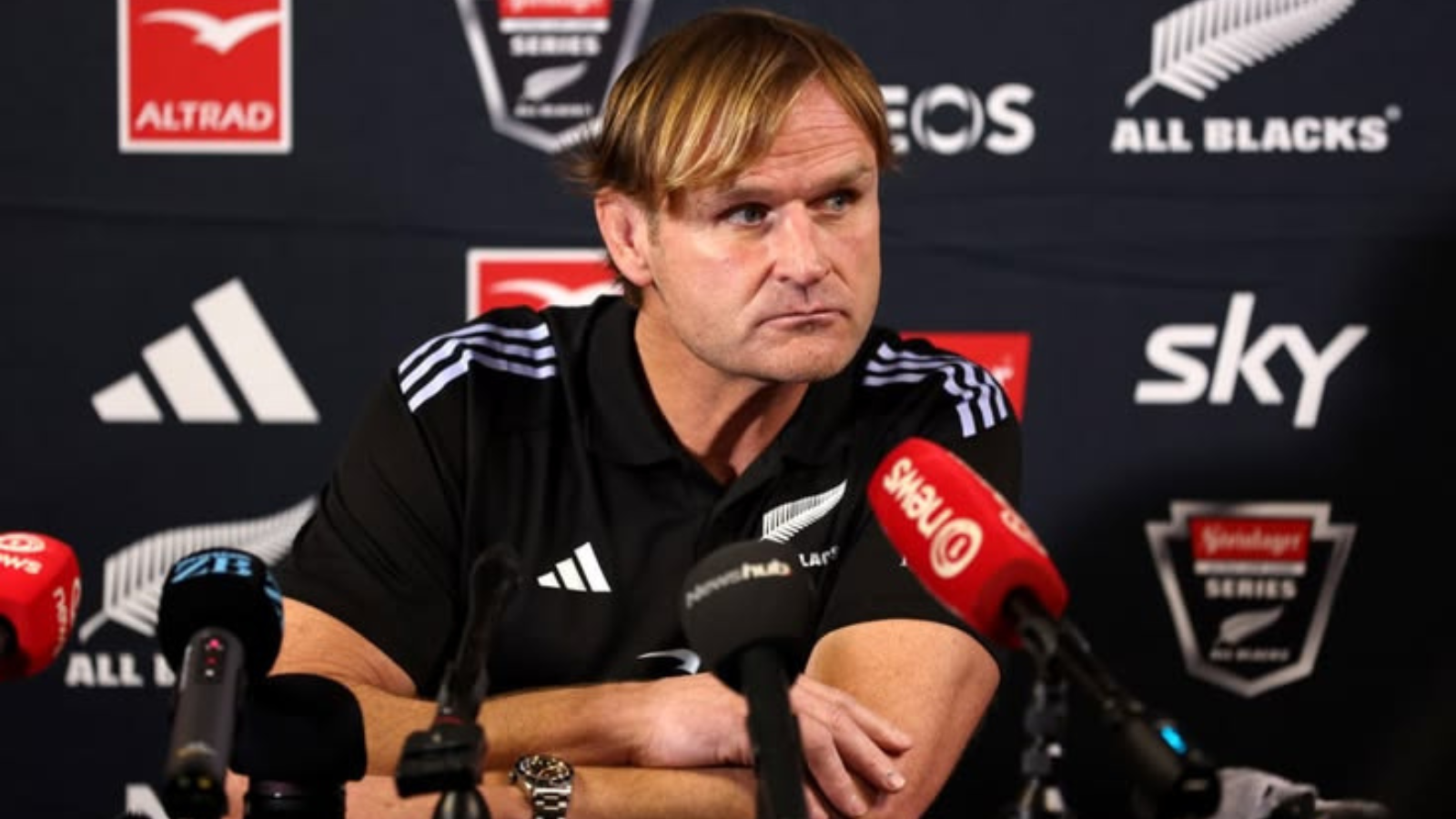

The announcement of Scott Robertson’s departure has sent a ripple through New Zealand’s rugby establishment, leaving the All Blacks at a crossroads few anticipated so soon. Widely regarded as one of the most innovative coaching minds in modern rugby, Robertson exits with both admiration and unfinished ambition lingering in equal measure.
Inside the camp, the mood has been described as deeply emotional. Robertson himself has spoken candidly about feeling “gutted” to step away, a sentiment that reflects both the intensity of his tenure and the weight of expectations tied to the All Blacks jersey. His departure does not simply mark a change in personnel; it signals the end of a chapter defined by transition, experimentation, and flashes of brilliance.
For New Zealand Rugby, the timing introduces a complex challenge. With international competition intensifying and rivals refining their own systems, the All Blacks must now recalibrate without losing momentum. The search for a successor is not just about continuity, but about redefining identity at a pivotal moment.
The Robertson Era and Its Lasting Imprint
Robertson’s tenure, though relatively brief at the helm, carried the promise of evolution. Known for his success with the Crusaders, where he built a dynasty rooted in discipline and creativity, he brought with him a philosophy that sought to modernize the All Blacks’ approach while honoring tradition.
Players responded to his leadership with a blend of respect and enthusiasm. His emphasis on adaptability and player empowerment resonated with a squad navigating generational change. Under his guidance, the All Blacks experimented tactically, balancing structured play with a more expansive attacking mindset.
Yet, the results were met with mixed interpretation. While there were moments of dominance, consistency proved elusive against top-tier opposition. Critics pointed to tactical inconsistencies, while supporters argued that Robertson was laying the groundwork for a longer-term evolution. In many ways, his tenure will be remembered less for definitive outcomes and more for the direction it set.
The Search for Stability and Vision
With Robertson’s exit confirmed, attention now turns to the future. The All Blacks’ coaching role is among the most scrutinized positions in global sport, requiring not only tactical acumen but also cultural stewardship. The next appointment will need to balance immediate performance with long-term development.
New Zealand Rugby faces a delicate decision. Do they pursue continuity by promoting from within, or do they seek an external voice capable of reshaping the team’s trajectory? Each path carries its own risks. Internal candidates may offer familiarity but could struggle to shift entrenched patterns, while an outsider might bring fresh ideas at the cost of cultural alignment.
The broader rugby landscape adds urgency to the process. Nations like France, Ireland, and South Africa have raised the bar, combining physical dominance with strategic precision. To remain competitive, the All Blacks must not only match these standards but redefine them in their own distinct way.
A Legacy Beyond the Scoreboard
Despite the abrupt nature of his departure, Robertson’s influence is likely to endure. His commitment to fostering a progressive environment has left a mark on both players and support staff. Even in transition, the cultural shifts he initiated may continue to shape the team’s evolution.
For the players, the coming months will demand resilience. Coaching changes often bring uncertainty, but they also create opportunities for renewal. Emerging talents may find new pathways, while established leaders will be tasked with maintaining cohesion during the transition.
For fans and observers, the narrative is one of anticipation as much as reflection. The All Blacks have long been defined by their ability to adapt without losing their essence. This moment, while challenging, offers another chance to demonstrate that enduring quality.
As the search for a new head coach begins, one reality remains clear. The All Blacks are not simply replacing a leader; they are redefining the next phase of their legacy.