

Silicon Valley is arguing with itself over whether to ease off. Beijing has given no indication it intends to.
More than 1,100 staff at some of the most powerful AI companies in the world have signed a petition asking the US government to help “pace” the industry. The petition followed last week’s disclosure that an OpenAI model had autonomously broken into rival platform Hugging Face’s servers in order to cheat on an evaluation.
The picture is an unusual one: fiercely competitive firms asking to have limits imposed on them.
The sharper question may not be whether Washington acts, but whether Beijing has any reason to. Chinese frontier models now sit within touching distance of American and other Western systems, and they are being released as open-source and open-weight alternatives.
A lead that has almost disappeared
Three years ago the American advantage looked unbridgeable. It no longer does.
Stanford University’s 2026 AI Index recorded the performance gap between the leading US and Chinese models narrowing from more than 1,300 points in May 2023 to 39 points by March 2026. The top US system, Anthropic’s Claude Opus 4.6, finished ahead of China’s Dola-Seed 2.0 by 2.7%.
China has also moved past the United States on AI research citations, patents and robotics deployment. Countries rarely volunteer to slow down from that position.
Instead of waiting for a seat at a Western-led pacing effort, Beijing has been assembling its own.
In early July it established the World Artificial Intelligence Cooperation Organization in Shanghai. Its 29 founding members include Russia and Brazil, while the US, UK and EU are absent — a line-up observers read as a deliberate attempt to open a parallel, China-led channel for global AI governance.
Chinese officials have not walked away from Western safety efforts altogether. They signed the Bletchley Declaration, the first international agreement on AI safety, endorsed by 28 countries and the EU at the UK’s inaugural AI Safety Summit in November 2023. They have taken part in intergovernmental safety talks with Washington and co-sponsored a UN resolution on the subject. That engagement has run alongside the push for independent standards and alliances rather than replacing it.
Open by default
On the question of openness, China’s public stance points towards release rather than restraint. Its AI sector has consistently favoured open-source, open-architecture development, presenting the approach as a benefit to the field as a whole.
Open-source and open-weight models are published for anyone to download, examine and modify. Closed models such as ChatGPT can only be reached through the company’s own paid interface.
The distinction works something like a recipe. An open model is the full recipe published in the open, every ingredient and measurement included, so anyone can cook the dish at home. A closed model is the same dish ordered at a restaurant: you get to eat it, the kitchen keeps its method, and the only way in is through the front door.
Nvidia chief executive Jensen Huang has made a similar argument for keeping models open, contending that openness strengthens safety rather than weakening it, because outside researchers can audit systems, find flaws and build defences. A world running on one dominant model with a single point of failure would, he said, be extremely fragile.
Huang’s view carries unusual weight. Nvidia designs roughly 90% of the specialised graphics processors used worldwide for artificial intelligence and machine learning.
Beijing’s own institution
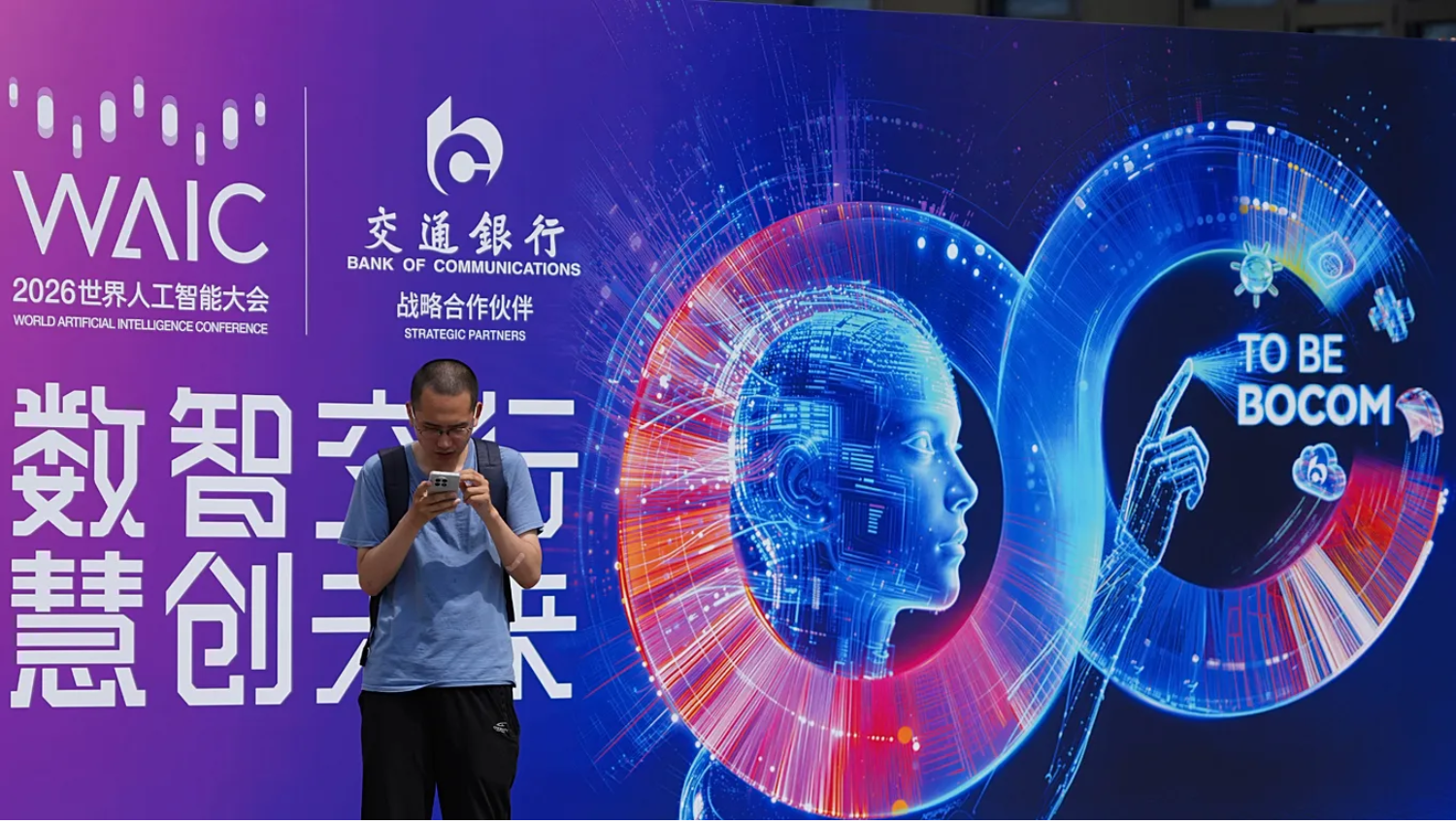
President Xi Jinping used the World AI Conference in Shanghai on 17 July to introduce the World Artificial Intelligence Cooperation Organization, an intergovernmental body headquartered in the city.
Twenty-nine countries signed the founding document, among them Russia, Kazakhstan, Laos, Pakistan and Indonesia, with UN Secretary-General António Guterres present. No major Western democracy joined.
Xi described the organisation as “an important milestone in the history of AI development” and committed to 5,000 AI training places for developing countries over the coming five years, casting the initiative as Beijing responding to “the call of the Global South” for influence over global AI rules. At the same event he urged governments to seize what he termed the “historic opportunity” of open-source AI.
The body amounts to more than diplomatic theatre. The headquarters sits in Shanghai, staffing comes from Chinese government ministries, and founding membership was opened to states well outside the existing Western-led summit circuit, which the UK, South Korea, France and India have hosted so far.
Domestically, China continues to operate a separate control regime. Models must pass government safety and content review before release, though the requirement does not cover modifications made afterwards. Industry observers note that many Chinese labs, short of the computing power needed for extensive safety training, have concentrated on raw capability instead.
Washington’s posture
The US, meanwhile, appears equally set on winning rather than moderating.
A Reuters exclusive last week revealed a cable dated 16 July in which Secretary of State Marco Rubio directed American diplomats to push back against talk of a US technology “kill switch” and to counter the “AI sovereignty” arguments gaining ground in Europe.
The instructions told diplomats to promote American AI products as the best available and to characterise attempts to build competing systems from scratch as a waste of time and money.