


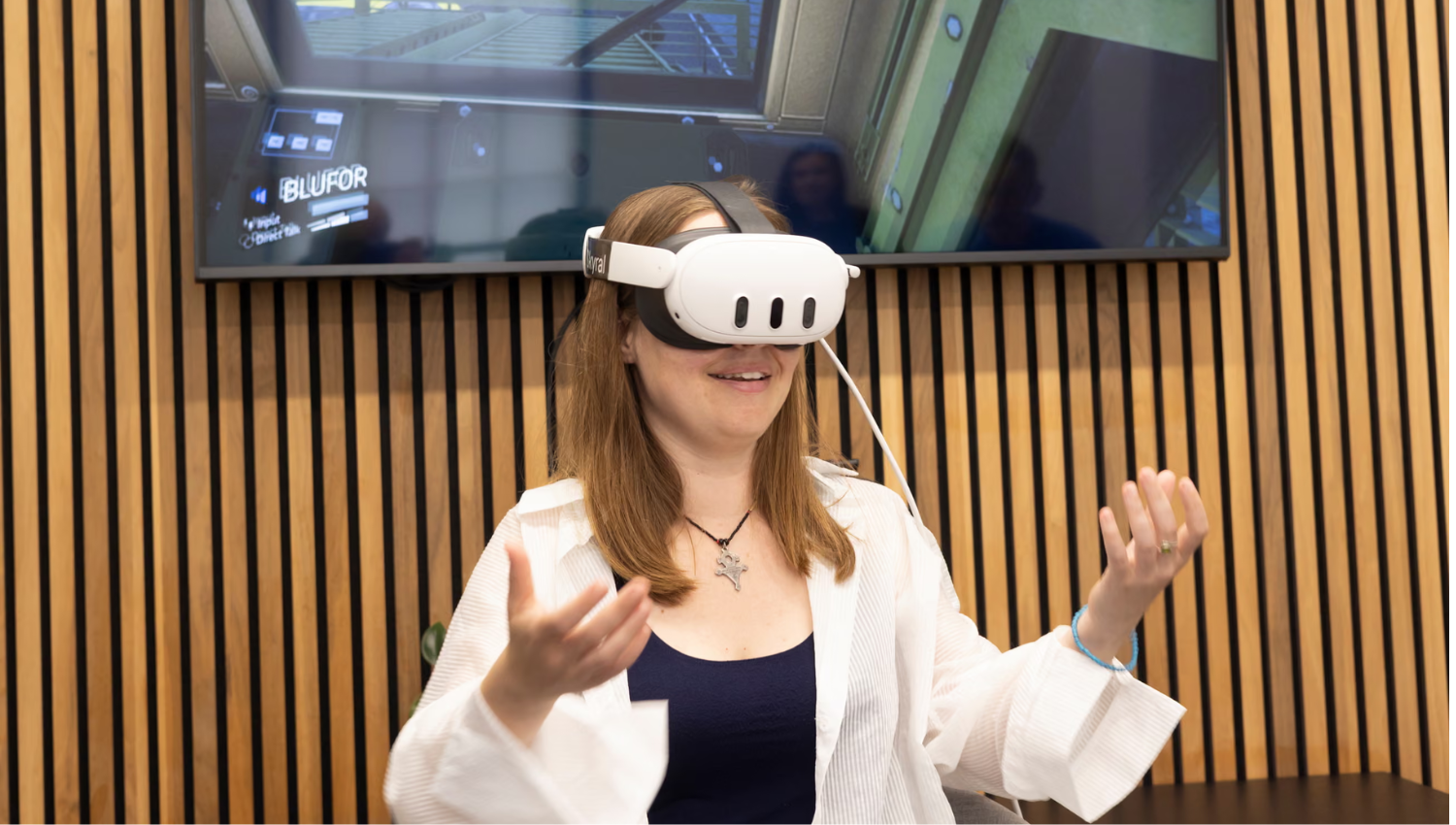
A NATO convoy rolls down a Riga street on a bright July day, past a pharmacy and a row of kebab shops. At an intersection in the city centre there is a blast, and the lead tank catches fire.
The streets are real ones — Lāčplēša iela and the downtown stretch of Tērbatas iela — and the shops sit exactly where they sit in life. The pedestrians who scatter and then gather at a wary distance are modelled on Riga’s actual population: a mix of ages, some sympathetic to NATO, some considerably less so.
None of it is happening. The whole scene runs inside a simulation built by Skyral, a British company in the consortium that recently secured a £2bn Ministry of Defence contract to train the British army.
Beyond the shooting game
Armies have trained in virtual environments for decades. The US army released America’s Army in 2002, a multiplayer shooter originally built for Windows that aimed to reproduce combat conditions and drew accusations of functioning as military propaganda.
A newer set of companies is chasing something else: dense, layered models of places and systems capable of capturing what happens after the first event. Skyral wants militaries to be able to reconstruct entire cities, and eventually entire countries. The point is not to teach a pilot the controls of an F-16 but to show soldiers and planners where a decision leads.
Consider a missile strike on a busy street. People run. Now put that same missile into a power station in the middle of winter, and the same population shelters somewhere entirely different.
How much any of this improves training remains thinly researched. Games do appear to work in general terms — earlier studies found that personnel trained on flight simulators performed considerably better in real conditions. But there are limits to how faithfully a scenario reproduces the world, and to how much of the learning survives contact with actual combat. What is beyond argument is the cost: simulations are cheaper and simpler to arrange than live drills, which is why defence budgets are absorbing billions of them. Imperfect replication still allows a soldier to rehearse the same skill repeatedly.
The underlying ideas have been maturing for years. Britain will be among the first militaries to weave the technology so tightly into how it prepares its forces. The contract lands in the middle of a broader argument about how much the UK spends on defence, and whether the figure matches the threats now facing it.
So how is this different from Call of Duty?
“Probably a bit more Fortnite on steroids,” says Naomi Hulme, Skyral’s co-chief executive, who founded the company with Jason Kennedy, previously of the military technology firm Raydon. Hulme came aboard after two decades at BAE Systems, shortly after the business was spun out of Improbable Worlds Limited, a software company built around gaming engines and the metaverse.
The starting point was Improbable’s existing virtual worlds. “If you swap, like, wizards for soldiers and dragons for tanks, it becomes really sort of defence applicable,” Hulme says. What followed was different in kind: a platform stacking layer on layer of information to produce a model of a real city and a real battlefield accurate enough to be useful.
Skyral describes the result as a “digital twin”. The phrase once meant a virtual copy of a machine — a car, say — used for predictive maintenance, simulating how brake pads might wear over five years. Its meaning has stretched to cover far more ambitious attempts to model reality so that armies, and also humanitarian missions and surgeons, can play out complicated choices before making them.
The term has become a buzzword, says Wiktor Dotter, chief executive of Power Size Technologies, a defence and automotive technology company based in Royal Leamington Spa.
His firm works with the British military, along with the US and a handful of others, on a different class of simulation. It builds virtual models of energy systems, from the batteries inside a tank to the solar panels at a desert camp, to help militaries work out how to electrify their equipment.
Defence is fertile ground for this, he argues, because procurement is costly and decisions move slowly through political channels. Trialling a new tank is a far heavier undertaking than trialling a new car. In his telling, defence development often ends up disconnected from usability because policy and rules drive everything. His pitch to the MoD is that solar panels in the desert or a hybrid battle tank can be tested in software first — the data, he says, is already there.
Cascading effects
Skyral’s proposition rests on the second-order consequences of battlefield choices: what combat does to supply lines, to critical infrastructure, to the behaviour of a civilian population. Delivering that means building exhaustive models of real places, Riga among them.
“In defence, you may well be making decisions without understanding the full consequences,” Hulme said. “What we do in a digital environment is you can test those decisions.”
NATO researchers have been pursuing digital twins as well, though usually on a tighter scope — models of underwater systems, for instance. The distinction is one of scale. Skyral reaches past any single system, folding in the layout of the electrical grid alongside the age and education profile of a real population.
“All of these things that up until now have been done in very siloed sort of modelling – you’re taking all of those models and bringing them all together,” Hulme said. “If you impact one, you see the cascading impact.”