

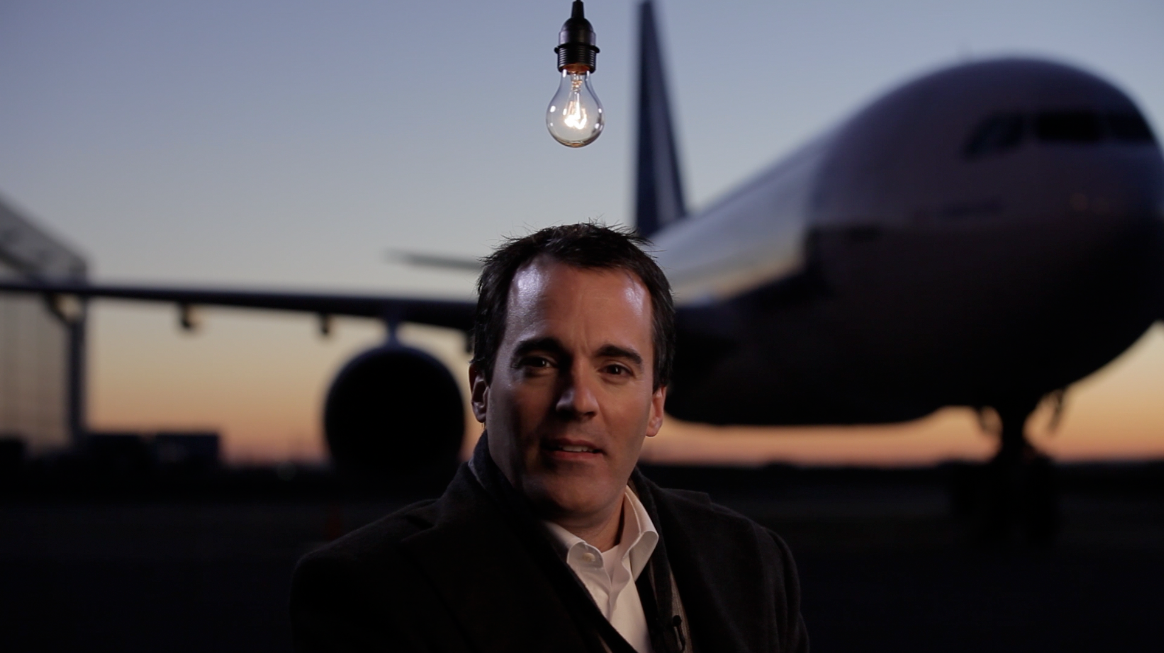

The first time many travellers noticed that flying could feel like something other than a test of endurance was not when the food marginally improved or the seats marginally reclined. It was when a small screen blinked awake in front of them and, for the first time, they were allowed to choose. A film, a game, a language lesson, a map tracking a thin line across oceans — suddenly, the cabin was not just a holding cell between departure and arrival. It became a space where time, however cramped, could be shaped.
Louis Bélanger‑Martin has spent three decades working in that thin space between confinement and choice. What began in the 1990s with games on seatback screens has become something more consequential: an attempt to turn entire airspaces into laboratories for artificial intelligence. His next experiment is unfolding over Australia, and the question is not whether he can build the technology. It is whether societies are ready for the moral weight that comes with turning passengers into data streams at 35,000 feet.
The Architect Of Captivity
Bélanger‑Martin’s career is a study in how capitalism learns to monetise boredom. With DTI Software in 1995, he convinced airlines that in‑flight entertainment could be more than a grudging cost; it could be a system of recurring revenues, a way to keep passengers docile and paying. Over time, those games and movies became part of an integrated ecosystem through Advanced Inflight Alliance and the Global Eagle Entertainment merger, a 650 million US‑dollar consolidation that stitched together content, connectivity, and distribution.
There is a blunt honesty in that history. The industry did not invest in better screens simply out of kindness. It did so because a distracted passenger complains less, buys more, and gives up something priceless: information about how they think, what they fear, when they spend. Bélanger‑Martin saw, long before most, that “captive environment” was not just a logistical phrase. It was a business model.
Australia As A Laboratory, Passengers As Subjects
His decision to root his next chapter in Australia is not romantic; it is strategic. Australia’s aviation market is consolidating, with a few carriers controlling most routes and capacity recovering unevenly between domestic and international networks. That concentration creates a controlled environment in which new systems can be rolled out, tested, refined.
At the same time, the country’s artificial intelligence sector is expanding sharply, fuelled by government ambitions and a growing pool of engineers. It is here that Bélanger‑Martin’s past meets his present. The same logic that once arranged games in a cabin now informs AI‑driven systems that can predict when a traveller will grow restless, when their attention will drift, when they might be most vulnerable to a well‑timed offer — or a nudge toward a carbon‑offset purchase that makes a flight feel less heavy on the conscience.
AI, in his hands, is not only a tool for operational efficiency. It is a mirror held up to human behaviour, fed by every tap, every pause, every skipped ad. When those systems adjust lighting based on biometric signals, reschedule meals around sleep patterns, or shuffle content to calm anxiety during turbulence, they create a flight that feels more humane. Yet they also deepen a dynamic in which the interior life of passengers becomes a resource to be mined.
The Moral Weather Above The Clouds
There is an old habit in technology writing to celebrate the ingenuity of the builder and ignore the condition of the built‑upon. Bélanger‑Martin’s story tempts that habit. It is easy to praise the cleverness that turned seatbacks into real estate and now seeks to turn airspace into a testbed for AI. But an honest reckoning demands more.
If Australia is to be a global proving ground for AI‑driven aviation, its citizens and regulators must ask what, exactly, is being proven. Will these systems reduce emissions in measurable ways, or merely rebrand consumption? Will they improve safety and reliability, or just optimise the sale of attention? Who owns the data extracted from every journey — and who is accountable when algorithms misread a body, misprice a route, or misjudge a human being?
Louis Bélanger‑Martin’s next big bet forces a choice on more than airlines. It confronts societies with a familiar trade: convenience and comfort in exchange for deeper intimacy with systems built to watch, predict, and influence. The skies over Australia are becoming smart. Whether they become just is a question no entrepreneur can answer alone — and one passengers can no longer afford to ignore.