

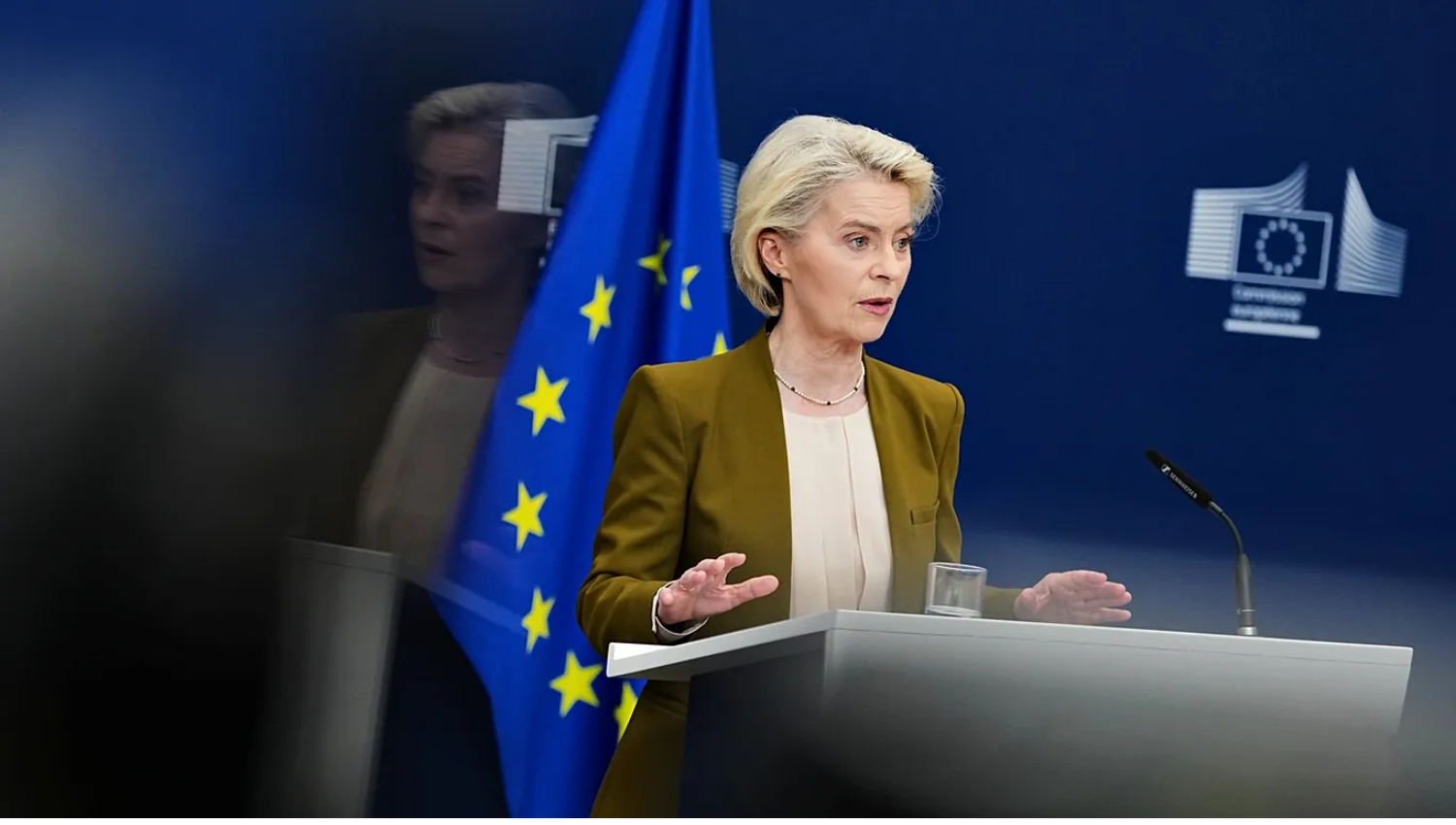
When European Commission President Ursula von der Leyen laid out the 20th package of economic sanctions against Russia, she built it around maritime services.
“On energy, we introduce a full maritime services ban for Russian crude oil. It will slash further Russia’s energy revenues and make it more difficult to find buyers for its oil,” she said in early February.
For Brussels, the measure was a chance to close a file that had been left open for years.
Unfinished business from 2022
The EU had first attempted to cut off maritime services for Russian tankers back in 2022, alongside its import ban on Russian crude and refined products. The logic was simple enough: a bloc that had stopped buying Russian oil should not go on helping to move it.
Inflation and energy prices were climbing at the time, and Joe Biden’s administration, wary of triggering further shocks, persuaded European capitals to adopt a price cap rather than an outright prohibition, keeping services legal under defined conditions. The EU agreed, and in December 2022 the G7 set the cap at $60 (about €52) a barrel — an untested instrument at the time.
Enforcement has been a running problem ever since. Moscow put its ageing “shadow fleet” to work evading Western oversight and selling crude above the ceiling. A flimsy attestation regime, volatile oil prices and the refusal of China and India to participate made the picture murkier still.
The conclusion in Brussels was that the cap had run its course and should give way to the full ban envisaged in 2022 — a prohibition covering everything from banking and insurance to shipping and flagging, aimed squarely at the machinery behind Russia’s energy earnings.
Then a run of developments, some domestic and some far outside the bloc’s control, some foreseeable and some not, turned the project upside down. The maritime services ban now sits dormant, shelved and largely unmentioned.
Here is how it unravelled.
A trap of her own making
The first obstacle was written into von der Leyen’s own announcement.
“As shipping is a global business, we propose to enact this full ban in coordination with like-minded partners after a decision of the G7,” she said in February.
Tying the measure to the G7, as the bloc had done with the price cap, placed the outcome beyond her reach. Donald Trump had already swung US policy on Russia and on sanctions sharply away from his predecessor’s course. His administration showed no appetite for the price cap, which it viewed as a Biden invention, and none for coordinated action of any other kind either. G7 sign-off looked improbable at best.
The Commission adjusted quickly. Days after von der Leyen spoke, Economy Commissioner Valdis Dombrovskis said a G7 agreement was not an “absolute precondition” for the ban and pledged that the bloc would not “shy away” from acting alone. Most member states took the same view, treating G7 backing as desirable rather than necessary.
British participation was another matter. The UK dominates the Protection and Indemnity insurance market that oil tankers depend on for liability cover at sea, which made London’s buy-in close to indispensable.
Then, late in the month, the United States and Israel struck Iran, the Strait of Hormuz shut and oil prices surged. Against that backdrop, a ban on maritime services looked far less attractive than it had weeks earlier.
The Mediterranean holdouts
Market chaos strengthened the hand of Greece and Malta, the two governments already sceptical of the measure and home to powerful maritime industries with long-standing involvement in Russian energy shipping. Cyprus shared their position but stayed publicly neutral while holding the rotating presidency of the EU Council.
Athens and Valletta argued that the prohibition would inflict losses on the European economy and hand the business to competitors outside the bloc, with Russia simply leaning on China and India to keep its oil moving. Behind closed doors, they said plainly that in the absence of a G7 deal they would use their veto.
The threat registered. When the sanctions package cleared in April, the maritime services ban was adopted in principle only, with activation deferred indefinitely pending “coordination and consideration” within the G7.
Commission officials maintained that the legal text was elastic enough for the ban to be triggered later. But with Greek and Maltese objections on the table, Washington uninterested, and London, Ottawa and Tokyo saying nothing, Brussels was left exposed.
By the time von der Leyen presented the 21st package in June, she made no proposal to activate the ban. She did not raise it at all. Her attention had shifted back to the price cap — the very mechanism she had set out to replace months earlier. At the G7 summit in Évian-les-Bains, France, the question went unaddressed.
Living with a veto
The measure now sits in an awkward half-life, with no clear path forward and no formal burial.
Sweden and Finland remain its loudest champions. The Baltic states, Poland, Denmark and the Netherlands back it too, as does Ukraine. All of them treat Russian energy income as the fuel supply of the war effort.
“Working towards a full maritime services ban is a crucial part of this effort, since it would substantially increase transportation costs and ensure that no EU entity is involved in supporting trade with Russian oil, coal or gas,” Swedish Foreign Minister Maria Malmer Stenergard told Euronews.
“A full ban would also be easier to enforce than the current oil price cap.”
Greece, Malta and Cyprus, for their part, insist on a G7 agreement first — a requirement some diplomats read as a device for keeping the ban permanently out of reach.
Athens has shown how far it will go. During fraught talks on the 21st package, Greece held out with its veto until it won an exemption allowing continued shipment of Russian LNG to non-EU customers past 1 January 2027, the original cut-off.
That episode drew attention to Dynagas, an LNG carrier operator, and its founder George Prokopiou. The billionaire also controls Dynacom, which provides tankers for Russia’s global oil trade. According to Financial Times estimates, Greek shipping firms including Dynacom have collected at least $3.8 billion (around €3.35 billion) from carrying Russian oil over the past three years — earnings that will keep flowing for as long as Athens blocks the ban.
The Commission is stuck in the middle. It has not disowned the sanction it authored, but it recognises that the political energy behind it has drained away and that pushing it now would be costly at home and abroad. Continuing volatility in the Middle East adds another layer of difficulty.
“A well-timed and well-enforced maritime services ban would squeeze Russia’s tanker capacity, raise transport costs and disrupt the Kremlin’s essential oil exports. But an abrupt ban could push up global oil prices, partly offsetting the hit to Russian revenues,” said Isaac Levi, a senior analyst at the Centre for Research on Energy and Clean Air.
“The EU should instead use this extraordinary leverage to crush Russia’s earnings without removing its oil from the market: rigorously enforce the price cap,” Levi added.
“Without serious enforcement, the price cap is a paper tiger — like setting a speed limit with no cameras, police or fines.”