
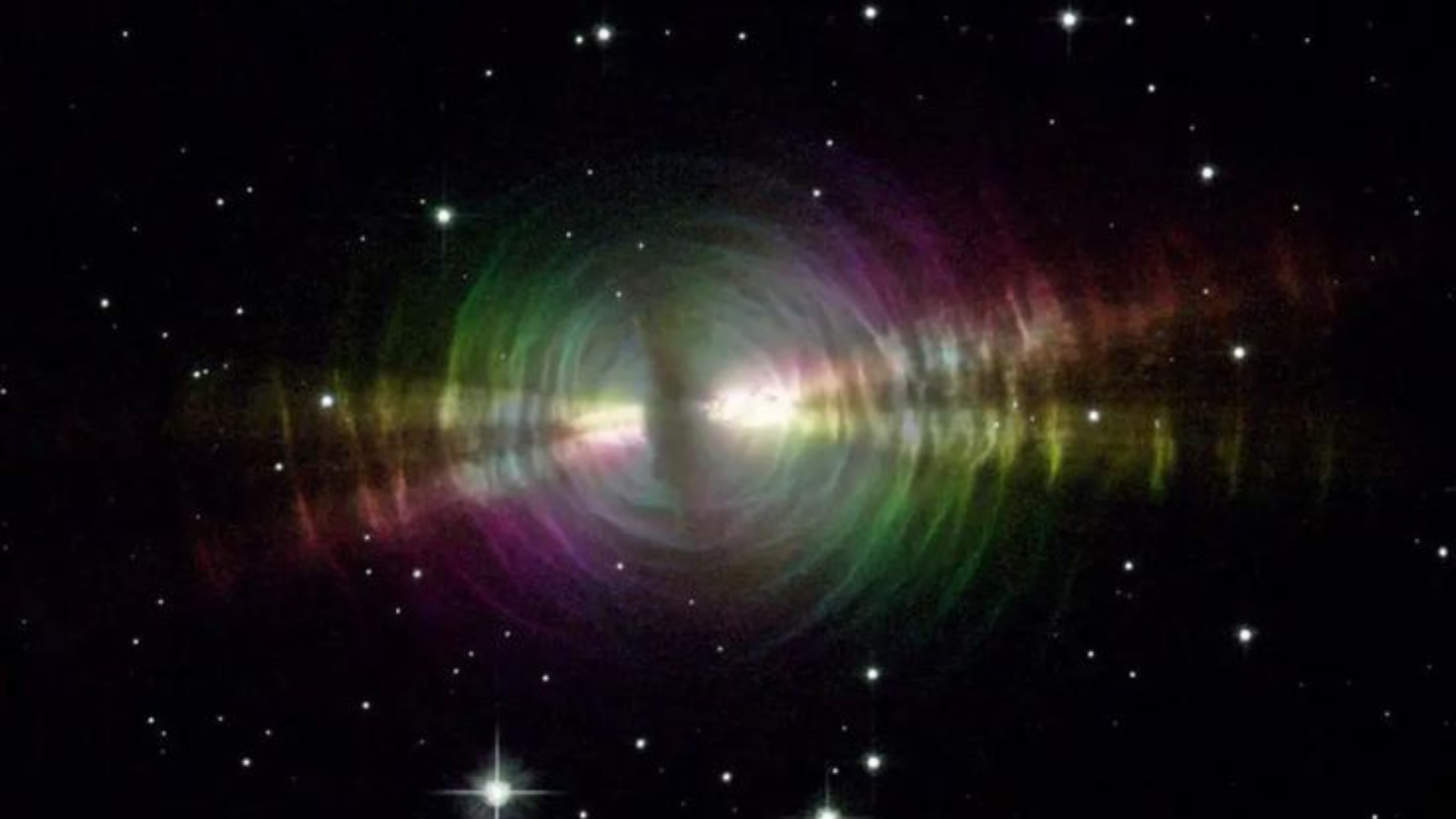

In space science, the moments that linger are often the ones that feel both distant and strangely intimate. NASA’s Hubble Space Telescope has done that again, releasing a new image that brings an elusive object into unusually sharp focus. The latest view centers on the Egg Nebula, a striking formation nearly 1,000 light-years away, captured in what NASA describes as the clearest look so far.
The image, shared publicly on Feb. 10 and detailed by the NASA Hubble Mission Team at the Goddard Space Flight Center in a Feb. 12 update, highlights a vivid contrast of illumination and darkness inside the nebula. In the scene, light and shadow appear to duel across lanes of dust, an effect shaped by newly expelled stardust. It is the kind of cosmic portrait that feels less like a static photograph and more like a snapshot of motion paused mid-breath.
Coming so soon after Hubble delivered crisp imagery of an uncommon lenticular galaxy, the Egg Nebula reveal underscores how quickly the telescope can pivot from one deep-sky wonder to the next while still producing results that excite scientists and casual stargazers alike. Even after decades of operation, Hubble continues to provide images that make the universe feel newly discovered.
A “Yolk” Hidden in Dust, in a Brief Phase of Stellar Change
The Egg Nebula sits in the constellation Cygnus, and its nickname is rooted in a simple visual metaphor. At its center is a star that cannot be seen directly because a thick cocoon of dust blocks the view, resembling a yolk tucked within an opaque white. That obscuration is not incidental. It is central to why the new image stands out, because the interplay of light around that concealed core helps researchers infer what is happening within and around it.
NASA characterizes the Egg Nebula as the first, youngest, and closest pre-planetary nebula ever identified. That label matters because it places the object in a transitional stage that does not last long on astronomical timescales. The pre-planetary nebula phase is thought to persist for only a few thousand years, making it a fleeting window into how certain stars shed material as they evolve. With that in mind, the clarity of the new Hubble image is more than aesthetic. It offers researchers a chance to study a rare chapter of stellar change while it is still underway.
That sense of urgency is part of the fascination. The Egg Nebula is not simply beautiful; it is temporally special. The dust and structure visible in the image reflect a recent outflow of material, and the dramatic lighting effects emphasize how that material sculpts what Hubble can see. For scientists, each improvement in detail can sharpen questions about timing, geometry, and the processes shaping the nebula’s form.
A Familiar Target, Seen Anew, From Hubble’s Orbit Above Earth
Although the current view is being celebrated as the sharpest yet, Hubble has visited the Egg Nebula before. NASA notes that the telescope first captured a visible-light image of the object on May 12, 1997 using the Wide Field and Planetary Camera 2. Years later, on April 3, 2003, Hubble’s Advanced Camera for Surveys produced another image that offered a different perspective on the nebula’s distinctive glow. A third major look followed when the Wide Field Camera 3 captured an additional view that was released on April 27, 2012.
Those earlier observations set the stage for today’s reveal, showing how Hubble’s suite of instruments has continued to refine humanity’s view of the same target over time. With each return, the Egg Nebula becomes less of a distant curiosity and more of a well-studied environment whose details can be compared, questioned, and better understood. The newest image fits into that longer story, adding a clearer chapter rather than rewriting the plot.
Behind the scenes, Hubble’s vantage point is key to why these images are possible. The telescope is the product of international collaboration between NASA and the European Space Agency, and it operates in low-Earth orbit, meaning it circles the planet at under 1,200 miles above the surface. NASA places Hubble at about 326 miles up, close enough that, in an imaginary straight-line drive upward, the travel time would roughly resemble a road trip from Baltimore, Maryland to Boston, Massachusetts.
Hubble’s operations are managed through a coordinated network. NASA’s Goddard Space Flight Center in Greenbelt, Maryland oversees the telescope and mission operations, with Lockheed Martin Space in Denver supporting mission operations at Goddard. Meanwhile, the Space Telescope Science Institute in Baltimore, operated by the Association of Universities for Research in Astronomy, handles Hubble’s science operations for NASA. Together, that infrastructure keeps the observatory working as it continues to deliver images that make faraway phenomena feel astonishingly near.