

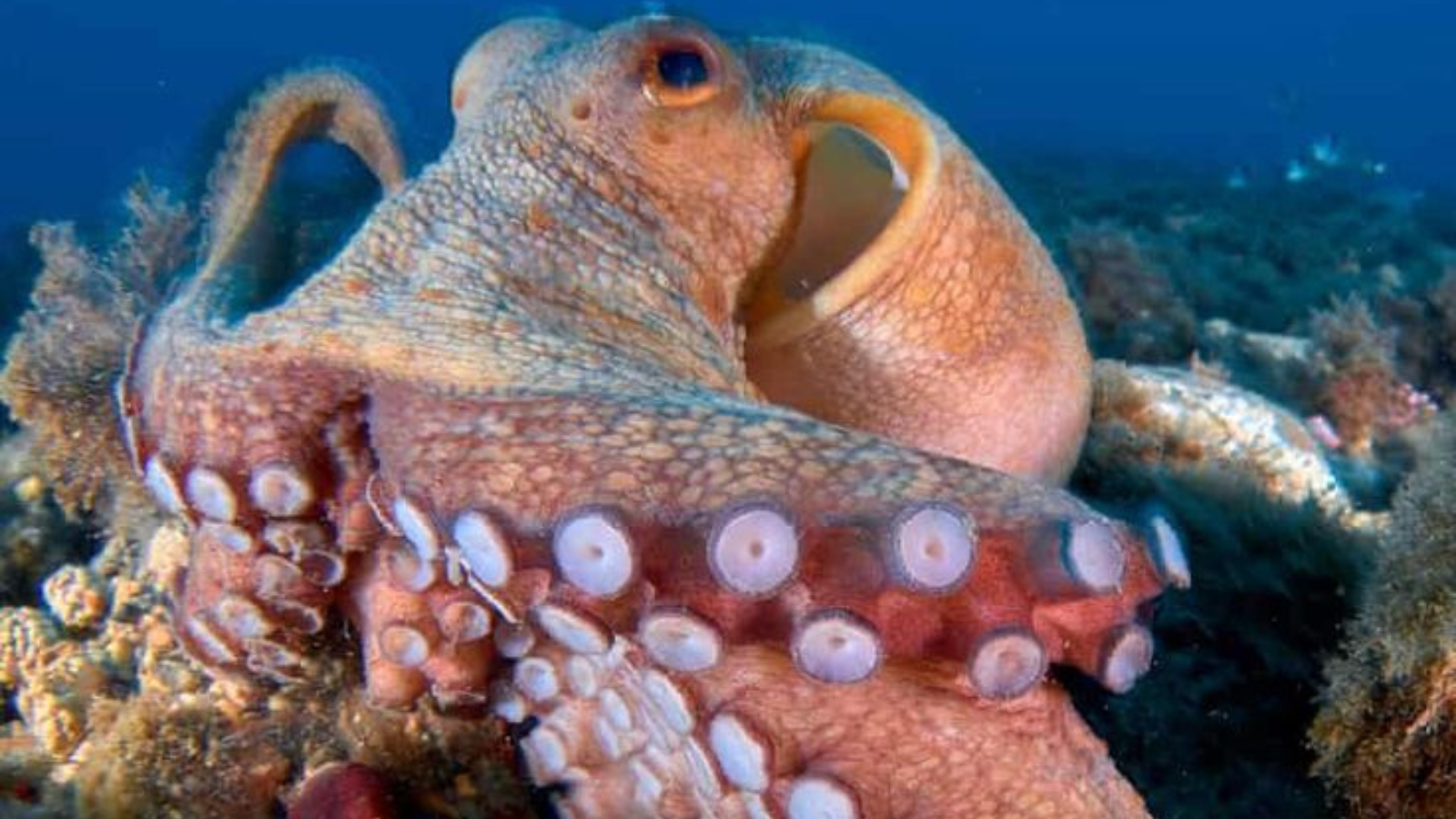

For more than a century, lab science has relied on a familiar cast of animals to answer foundational questions about biology. Mice and fruit flies, in particular, have become staples because researchers understand them so well and can interpret experimental results against decades of accumulated knowledge. Now, a different kind of organism is being considered for a similar role, one with a large brain and an unusually complex body.
As reported by NPR, researchers are exploring whether octopuses could serve as an alternative to the traditional lab “rat” model. The idea is not a novelty for novelty’s sake. It is driven by the possibility that octopuses can help scientists learn more about living systems where sophisticated cognition and intricate biological functions are central to the questions being asked.
At the heart of the interest is the octopus itself: a cephalopod that stands apart from many commonly studied lab organisms. The hope is that by studying animals from this diverse group, researchers can expand what is currently possible to investigate using standard, well-worn laboratory models.
Mapping the Cephalopod World at Marine Biological Laboratory
At the Marine Biological Laboratory in Massachusetts, researcher Josh Rosenthal has pointed to the limits of relying solely on the usual organisms that science has already “well analyzed.” Those models remain invaluable, but they can only take researchers so far when the goal is to understand biology that involves a larger brain and more elaborate body functions. Studying cephalopods, Rosenthal suggests, may open pathways to discoveries that are harder to reach through fruit flies and mice alone.
To build that pathway, MBL researchers have been gathering specimens from a range of cephalopod species. The purpose is straightforward but ambitious: to widen their understanding of cephalopod genetics, trace key elements of their life cycles, and document the biological processes that shape how these animals develop and function.
That foundational knowledge matters because it creates a reference point for everything that follows. The long-term aim is to make cephalopods less like unfamiliar oddities and more like established research organisms, ones scientists can handle with the same confidence and interpretive clarity they bring to laboratory mice. In that sense, the current work is about building a baseline that future experiments can reliably stand on.
Early Steps, Unmapped Ground, and Ethical Commitments
NPR characterized MBL’s effort as being in its earliest stage, which also means the researchers are operating in territory that is not fully charted. Unlike long-established lab models, cephalopods do not come with the same extensive playbook of standard practices and assumptions. Developing that shared understanding is part of what makes this research both challenging and potentially valuable.
The work also sits within a regulatory landscape that differs from what many people associate with laboratory testing. In the United States, there is no federal law specifically governing experiments on non-vertebrates, according to the report. Even so, Rosenthal emphasized that MBL approaches the ethical dimension with seriousness rather than treating the absence of a specific federal rule as a blank check.
The team’s intention is to develop a policy tailored to cephalopod research, with the explicit goal of safeguarding animal wellbeing. As they move forward, their focus includes the care and oversight of nearly 3,000 animals described in the report as strange creatures, all of which would remain under close attention and stewardship while the laboratory learns how to study them responsibly.