
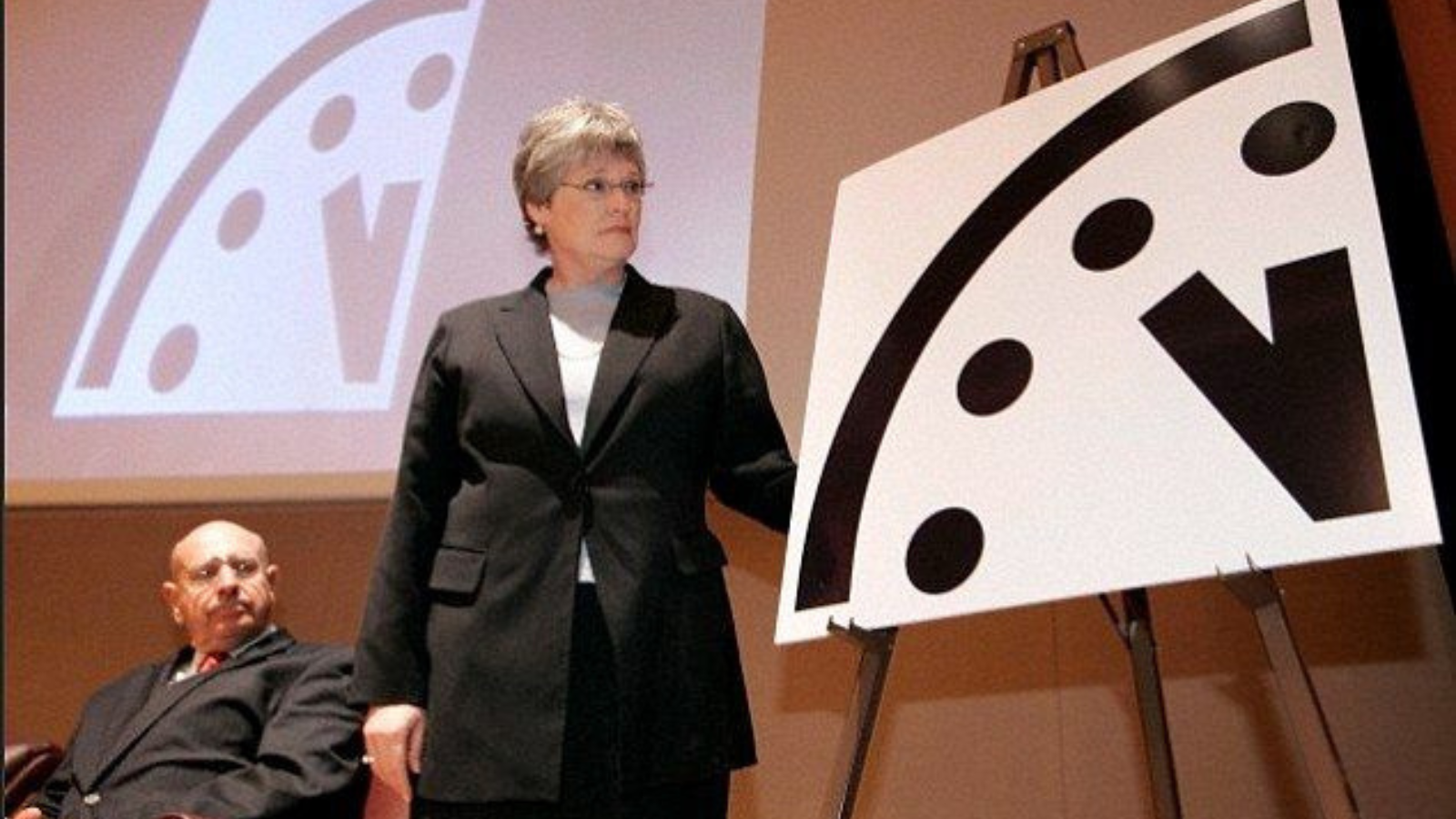

It looks like an old-fashioned watch face, but the Doomsday Clock was never meant to function like one. It is a symbolic gauge, maintained by experts at the Bulletin of the Atomic Scientists, designed to translate sprawling global dangers into a single, easily understood image: how close humanity appears to be to catastrophe of its own making. In a world crowded with data, forecasts, and competing headlines, the clock’s power has always been its simplicity. Each annual adjustment is meant to land as a warning people can feel, not just read.
The idea has been around for decades, reaching back to 1947. The image was created by Martyl Langsdorf, who was married to a physicist involved with the Manhattan Project. From the start, the message was educational and urgent, a visual prompt to help the public grasp what nuclear threats could mean for life on Earth. Over time, that metaphor expanded into a broader measure of planetary risk, but it still carries the same core premise: the tools humans build can also undo them.
The clock’s updates follow a familiar rhythm. Each year, the Bulletin issues a new “time,” offering a snapshot of where the world stands relative to midnight, the symbolic point of no return. In 2026, that ritual landed with renewed intensity, with experts pointing to an increasingly fraught global landscape and urging people to pay attention to what the new setting implies.
Why the hands keep moving closer
The Doomsday Clock has never been static, and its timeline reads like a condensed history of escalation and restraint. The hands began shifting in response to nuclear developments as early as 1949, after the Soviet Union used a nuclear weapon. That moment signaled that the nuclear age had become a shared reality, and the clock’s face would reflect that growing peril.
Several years later, the world watched the risks compound. In 1953, the United States detonated its first thermonuclear device, and the Bulletin’s account notes the clock tightening to two minutes to midnight. The movement was not subtle. It was meant to communicate that technological leaps in weaponry were compressing the margin for error, shrinking the distance between geopolitical brinkmanship and irreversible consequences.
Yet the clock has also moved in the other direction when tensions eased. In 1960, the hands were pushed back to seven minutes to midnight, and in 1963 they shifted again following the signing of the Partial Test Ban Treaty. Those changes underscored an important point that still underpins the clock’s existence: human decisions, especially cooperative ones, can change the trajectory.
That long view makes the recent pattern more alarming. A run of heightened warnings arrived in close succession in 2023, then again in 2025, and again in 2026. In the latest update, the Doomsday Clock was set at 89 seconds to midnight, marking yet another tightening of the gap. In its statement, the Bulletin tied the shift to rising strain among the United States, Russia, and China, alongside the breakdown of global understandings that had helped keep the threat of war in check. The organization characterized the moment as a failure of leadership, language that conveys frustration as much as fear.
Midnight, and what people can still do
The closer the clock inches toward midnight, the more it forces a difficult question: what, exactly, does midnight represent? It is not a prediction of a single event arriving at a scheduled hour. Instead, it stands for a threshold beyond which the planet becomes unlivable, driven by overlapping dangers the Bulletin has repeatedly emphasized, including nuclear risk, climate change, biological threats, and disruptive technology.
In the Bulletin’s framing, the approach toward midnight also reflects something cultural and political, not just technical. Experts warn that many societies have become numb to the intricate realities of global relationships, trading careful diplomacy for nationalism. That shift matters because the threats the clock is meant to capture are not problems any country can solve alone, and not problems that respect borders when they spill over.
The grimness of the message is hard to miss, especially with the clock sitting so close to its symbolic endpoint. But the people who maintain it also insist that the purpose is not despair. Even with the hands near midnight, they argue that there remains time to act, and that the future is still responsive to choices made now. That work can take different forms, from repairing damaged political relationships to confronting emerging challenges such as how artificial intelligence should be governed.
In 2026, the Bulletin’s president underscored that point publicly, holding a press conference to explain the change and to call for international cooperation, while urging major governments to step up. The clock, in other words, is meant to be heard as a demand as much as a diagnosis: the risks are escalating, but the outcome is not fixed, at least not yet, if those with power decide to do what is right.