
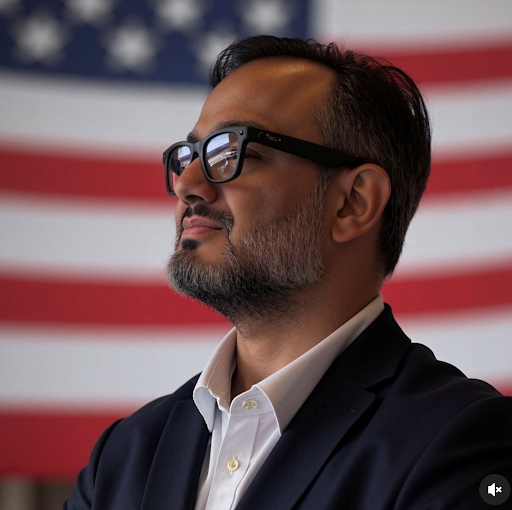

There is a moment in wrestling, fractions of a second long, when you are on your way to the floor, and you already know it. The ground is coming. The points are gone. Everyone in the room can see it. What happens in the moment after that one, the choice made in the space between impact and response, tells you everything you will ever need to know about a person. Hooman D. Tavakolian has spent his entire life in that space. Not falling. Not quite standing. Deciding.
Long before Hooman D. Tavakolian became a business executive, wrestling champion, humanitarian, and nonprofit founder, he was a kid sitting with a question that refused to leave him alone.
Why do some people quit, and others refuse to?
He would spend the next several decades living his way toward the answer. Not in theory. Not in carefully constructed thought experiments. But in the real weight of hard years, in the particular silence of a setback nobody witnesses, in the slow and unglamorous work of becoming someone worth becoming. By the time the answer finally arrived, it wasn’t a revelation. It was a recognition. Something he had known in his body long before he could say it out loud.
The difference was never talent. It was never intelligence, luck, or the right connections arriving at the right time. The difference was simpler and more demanding than any of those things.
It was the willingness to keep going after life gave you every reason to stop.
What Adversity Builds That Comfort Cannot
Growing up on the affluent North Shore of Long Island, Tavakolian was surrounded by people who appeared to have advantages he didn’t. He could have measured himself against that gap. He chose instead to measure himself against what he could control, which was everything inside him and nothing outside of it. The obstacles became fuel. The setbacks became teachers. Looking back, he will tell you those early years of friction were among the most valuable things that ever happened to him, not in spite of what they cost, but precisely because of it. Comfort, he learned early, rarely builds anything lasting. Adversity builds the structure that holds the rest of your life up.
Then he found wrestling, and everything he had sensed became concrete.
The mat is a particular kind of teacher because it will not let you hide. There are no systems to game, no first impressions to manage, no charm to deploy. There is only what you are made of when another person is trying to take you down. Tavakolian lost matches. More than he expected to. He lost in ways that were public and personal and taught him things that winning never could have. What he found in those losses was not discouragement but a discovery: you can stay inside a hard moment without being destroyed by it. You can absorb the worst a situation offers and still be standing on the other side. That is not a minor lesson. That is the whole game, transferred across every context life would eventually throw at him.
The sport stripped everything down to its essential question: when it gets hard, what do you do?
His answer, forged over years and losses and long practices in rooms that didn’t care whether he was tired, became the bedrock of his entire life. You stand up. You adjust. You move forward. You do it again.
The Slow Architecture of a Meaningful Career
The years that followed the mat were not clean or linear. They rarely are for people building something real.
There were stretches in his career in global finance where progress was invisible, where the work was accumulating into something that hadn’t yet shown its shape. There were plans that unraveled quietly, opportunities that closed before he could reach them, and long seasons where the only thing keeping him moving was the refusal to let stopping feel like an option. He was not fueled by certainty. He was fueled by something more durable: the discipline of someone who had learned, on a wrestling mat in a room that didn’t care, that the scoreboard doesn’t move for the person who gives up.
Success, when it arrived, brought something unexpected with it.
It brought the realization that achievement alone was never the point.
The purpose of achievement, he came to understand, is contribution. A title is a position. A career is a trajectory. But a life is measured in something altogether different: in the people who are better off because you were here, in the doors you held open after others held them open for you, in the quiet accumulation of small moments where you chose someone else’s possibility over your own comfort.
That understanding didn’t just change his perspective. It changed his direction.
The People He Went Back For
The roads Tavakolian has chosen since reaching that understanding are not roads most people with his level of professional success ever walk down.
He has traveled to remote mountain communities near the borders of Afghanistan. He has sat with people in villages where clean water is uncertain and educational opportunity for girls is not a given but a fight. He has looked at circumstances that most people observe from a careful distance and decided, again and again, to move closer rather than away. Through Hoomanities, his nonprofit initiative, he has worked to build schools, support athletic programs, and create access to education in communities where none of those things were guaranteed. He does not talk about this work in the language of generosity. He talks about it in the language of obligation.
If someone helped open a door for you, you go back and hold it open for someone else. That is not charity. That is the debt a meaningful life carries.
Ask him about his proudest accomplishments and he will not reach for titles or championships or positions held. He will tell you about the child who now has access to education. The young athlete who found confidence. The student who discovered that possibility existed where they had only ever seen its absence. His measure of success is quietly radical: if one life improves because he showed up, the effort was worth it.
He is also honest about what made any of it possible. No one gets through the kind of life he has built without people beside them. Coaches who challenged him before he was ready to be challenged. Mentors who offered clarity when the path was genuinely unclear. And Lorelei, whose steadiness and wisdom helped him navigate storms that could not be navigated alone. He has never forgotten that every accomplishment carries more fingerprints than one.
That gratitude became a philosophy. Together with the grit that carried him through the hard years, it became the foundation of everything.
Grit without gratitude is just endurance. Gratitude without grit is just sentiment. Together, they become something that actually changes a person, and changes what that person does with their time on earth.
In the end, the people who leave the greatest mark on the world are rarely the most talented. They are the most relentless, and the most willing to use what they’ve built for someone other than themselves.
For Tavakolian, that has never been a philosophy he arrived at.
It is a life he has been living, one decision at a time, for as long as he can remember.
Get back up.
Then help someone else do the same.