

On a working weekday in Sydney, during peak hour, lanes of the Sydney Harbour Bridge and the Cahill Expressway went quiet. There was no accident and no roadwork. George Miller needed a live motorway for Mad Max: Fury Road, and a small company from the inner-west suburb of Marrickville had spent months aligning approvals, timing and public impact so a Hollywood production could borrow one of the busiest crossings in the Southern Hemisphere while the city kept moving around it.
The company was CATO Group, and the job says something about a corner of the Australian economy that almost nobody examines. Screen production in Australia hit a record $2.7 billion in 2024/25, up 43% on the prior year, according to Screen Australia’s Drama Report published in December 2025. Every one of those productions, along with every marathon, street parade and New Year’s Eve fireworks display, depends on an unglamorous trade: the people who close roads, move crowds and satisfy councils that nothing will go wrong. The economics of that trade are being reshaped by consolidation, and CATO has made a deliberate bet against the direction most of the industry is heading.
The cheapest line item is the one that stops everything
Traffic management barely registers in a production budget or a construction program. Its failure modes are what make it matter. A rejected traffic plan or a late permit does not cost a company the price of the traffic contractor’s invoice; it costs idle crews, stalled concrete pours and slipped schedules. That asymmetry has turned the sector into a volume business dominated by large national providers. Altus Traffic, the biggest of them, operates across six Australian states, a scale documented even by competitors publishing comparisons against it.
CATO went the other way. Founded in 2011 as CATO Location Services, the firm started as a fixer for film and television crews in Sydney, then expanded into construction, major events and government work without leaving its niche: the jobs where coordination, not headcount, is the product. The company drafts the traffic management plans, draws the on-site guidance schemes, lodges the road occupancy licences and supplies the licensed crews, one point of accountability across paperwork and pavement. It is pre-approved for Local Government Procurement in New South Wales and South East Queensland, and it holds security master licences in both states.
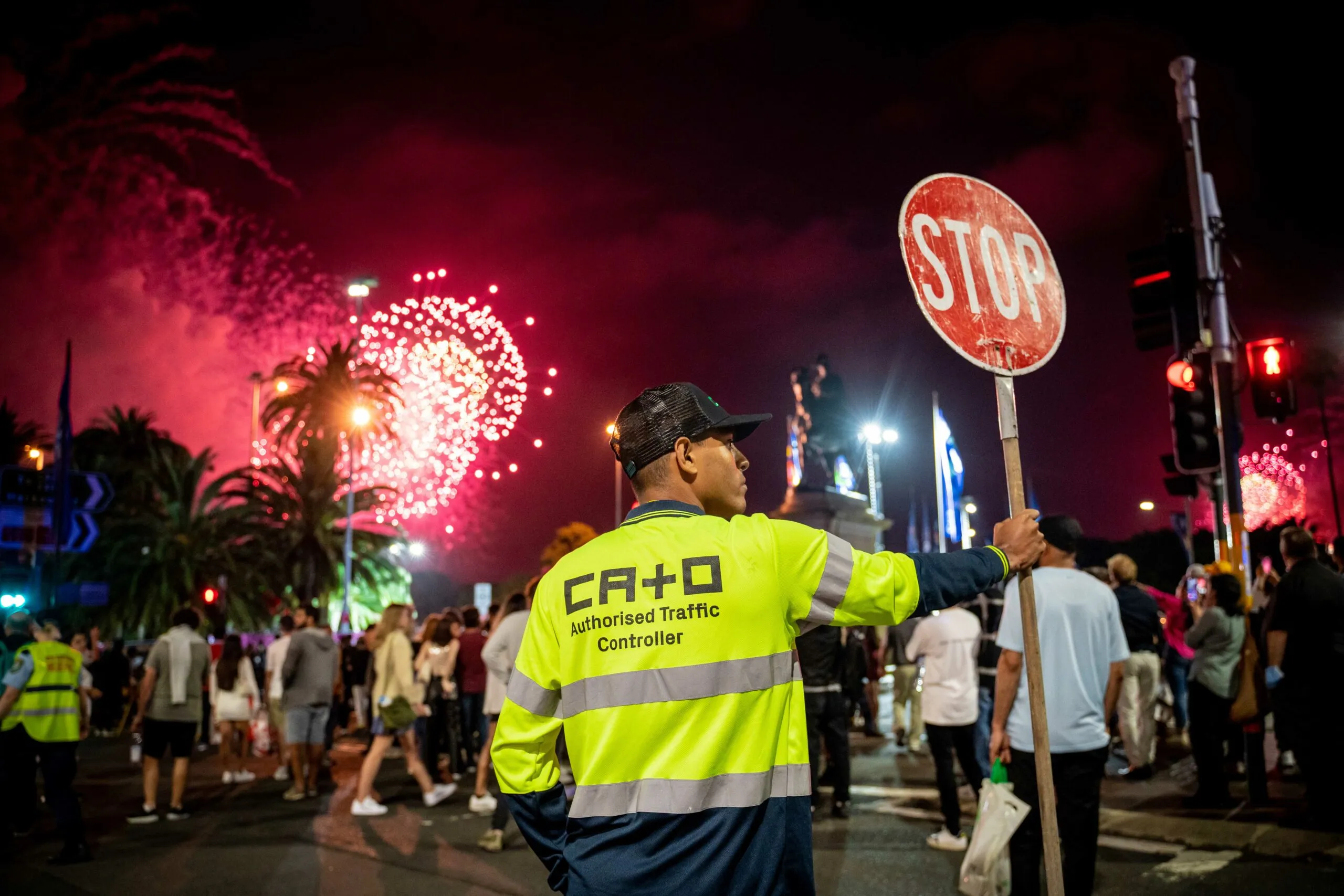
The client list reads like a film festival program crossed with a council agenda. Disney, Sony Pictures, 20th Century Fox and Netflix’s Heartbreak High sit alongside City of Sydney and North Sydney Council, which have engaged CATO for New Year’s Eve operations every year since 2017. For the Sydney WorldPride March in 2023, by the company’s account, it coordinated the safe movement of 50,000 people through a live pedestrian environment. When the Sydney Marathon made its debut as a World Marathon Major, CATO ran traffic and security. “What people see are the moments, the hallmark events,” the company wrote in a recent post. “What often goes unseen is the level of coordination behind them.”
The growth market nobody advertises
Two forces are expanding the premium end of this business. The first is the screen boom. Screen Australia’s data shows a record $1 billion spent by 20 international features filming in Australia in 2024/25, and Queensland captured 34% of state production spend, ahead of New South Wales at 31%. CATO’s recent expansion into South East Queensland, through a dedicated Queensland entity, tracks that shift almost exactly.
The second is hostile vehicle mitigation, the physical barriers and operational planning that protect crowds from vehicle attacks. Councils, police and insurers increasingly expect an explicit HVM answer in every major event plan, and CATO has delivered HVM for Sydney’s New Year’s Eve celebrations, among the most scrutinized public gatherings in the country. The firm has also collected the industry’s attention: the Traffic Management Association of Australia named it a finalist in its Excellence Awards for Traffic Management Project or Event of the Year. Its sister companies extend the same logic to the film set itself, including Honeywagons, a make-up and dressing-room vehicle business the company says has operated for 40 years, and O My Pod, whose transportable luxury green rooms housed Bad Bunny on his Australian stadium run.
A fair observer would raise the obvious risks. Traffic control is labor-intensive and thin-margined, and the national consolidators can underprice boutique operators on routine work, which remains most of the market. CATO discloses no revenue or headcount figures, so its financial resilience cannot be independently assessed. Its premium niche is also tied to two cyclical funders, screen production and council event budgets, and Screen Australia’s own report notes the number of Australian titles entering production fell from 89 to 71 last year even as spending rose. A boom built on a limited number of high-budget international features can retreat as quickly as it arrived.
The counterargument is the one CATO’s whole history makes: coordination knowledge compounds in a way cones and utes do not. Fifteen years of learning what each council wants to see in a plan, and being the contractor two councils rebook for the most-watched night of the year, is not a moat a depot network replicates quickly.
The company’s founder-CEO, Kieran Cato, spends one night each winter sleeping outside as a six-time ambassador for the Vinnies CEO Sleepout. The other 364 nights, his firm’s preferred outcome is that nobody notices it was there at all. As the company put it about the bridge it has closed for filmmakers and fireworks alike: “94 years on, it’s more than a bridge. It’s a stage for moments that define the city.”