

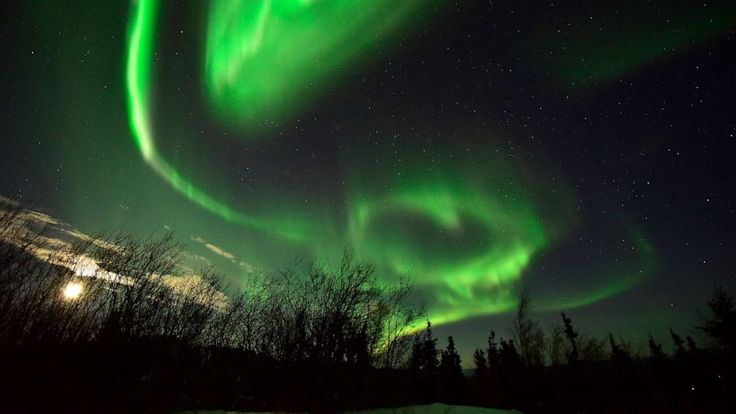

A striking burst of the northern lights had thousands looking skyward this week, sparked by an unusual surge of solar activity. A strong geomagnetic storm energized Earth’s upper atmosphere and helped the aurora borealis appear in parts of the United States where it is not commonly visible.
For several days, the National Oceanic and Atmospheric Administration tracked a run of intense coronal mass ejections, the large releases of plasma and magnetic energy that can stream outward from the sun and collide with Earth’s magnetic field. The storm climbed to a G4 level, labeled “severe” on the five-step geomagnetic scale.
As charged particles arrived, they interacted with gases high above the planet and triggered the familiar glow associated with auroras. That process caused electrons and atoms to emit light, forming the moving bands and curtains that define the aurora borealis.
Why sightings spread across uncommon states
What made this event stand out was its reach. Reports placed the lights far south of their typical range, with sightings noted in states such as Alabama, Texas, Florida, and even parts of California, areas that usually do not experience frequent auroral displays.
There was also reason for many people to keep watching into the night. Accounts indicated that at least 17 states in the continental U.S. fell under aurora watch, and clearer skies in some locations improved the likelihood of seeing activity.
For observers outside the usual aurora zones, the best odds still came down to conditions on the ground. Dark surroundings away from city glare and a cloud-free sky mattered, and the display tended to favor the hours from dusk into early morning depending on location, with viewers generally looking north or closer to overhead when farther south.
Beauty with real-world effects
On the surface, the northern lights were simply a vivid natural performance, with green, pink, and purple arcs lighting up the sky. At the same time, the same geomagnetic storm driving the spectacle carried practical consequences, because severe conditions can disrupt technology including power grids, satellites, radio communications, and GPS.
The timing also fits a broader pattern of solar behavior. Roughly every 11 years, the sun enters a more active phase, and Solar Cycle 25 has already drawn attention for exceeding some expectations.
In this case, an X5.1-class solar flare helped trigger a coronal mass ejection that fed into the storm, and overlapping ejections intensified the impact. The result was an aurora display extending well beyond its usual northern boundaries, a reminder that space weather can both impress and influence life on the ground.