


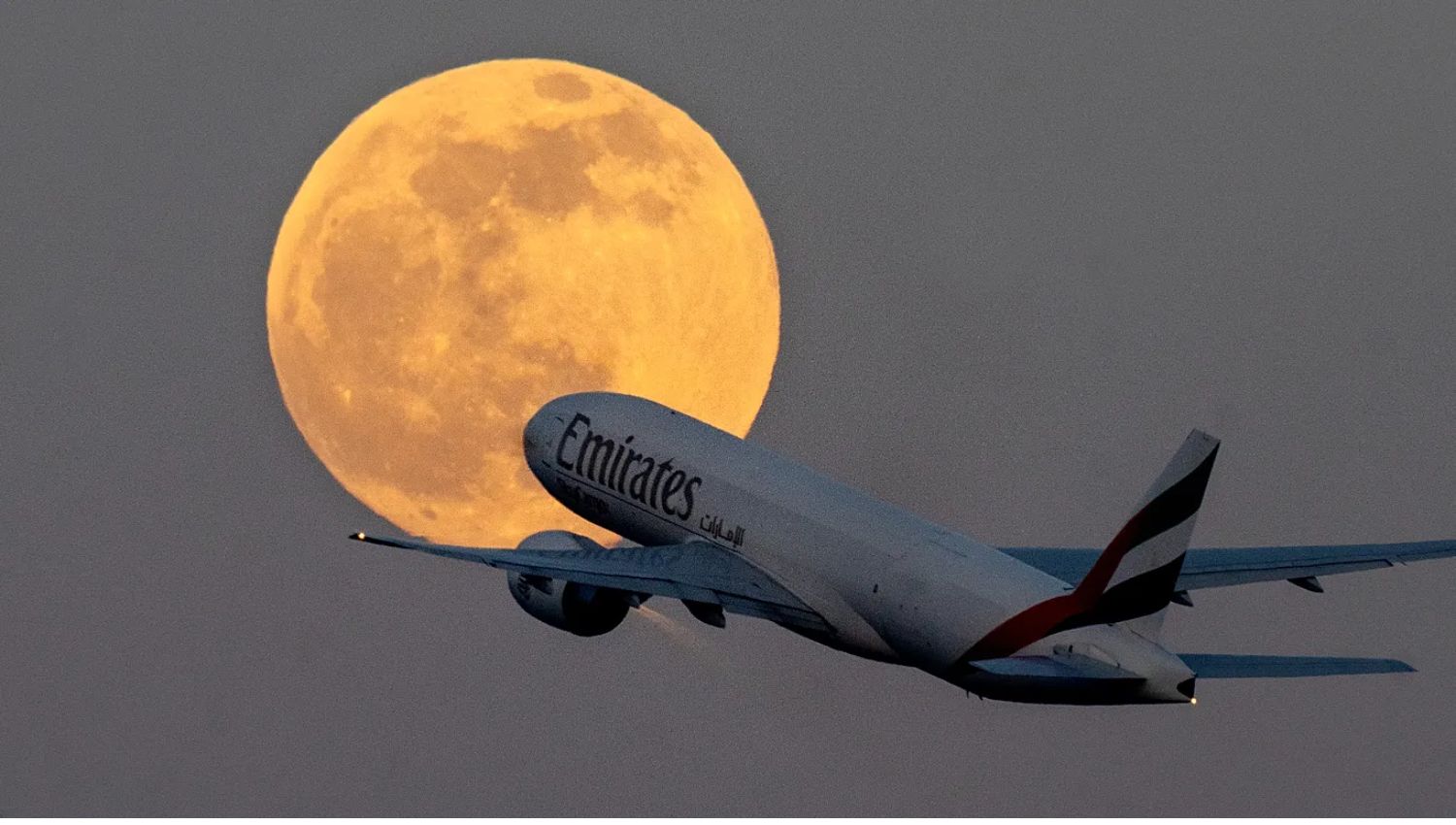
Nine airlines pulled in a combined $25.11 billion (€22bn) in their latest annual results, with Emirates once again sitting at the top of the pile. Yet these figures tell the story of an industry frozen in time — captured just before the Iran war upended global aviation.
The world’s leading carriers delivered record earnings in their most recent financial reports, with the top nine collectively banking $25.11 billion (€22bn), based on an analysis of industry-wide net earnings compiled by Dubai-based investment firm One Investments.
Emirates holds the number-one spot for the second year running — but both the details and the timing carry heavy weight.
The airline announced a record $5.4 billion (€4.7bn) net profit for the first quarter of the year, the strongest performance in its history and, according to the carrier, the best across the entire industry. Chairman Sheikh Ahmed bin Saeed Al Maktoum acknowledged, however, that the final month brought serious difficulties after the outbreak of the Iran war forced the closure of Gulf airspace at the end of February.
Delta comes in second at $5 billion (€4.3bn), holding its position as the top American carrier, followed by United at $3.4 billion (€3bn).
Europe’s top performers round out the middle of the pack. Ryanair posted €2.26 billion in its financial year to March, a 40% jump driven by climbing fares, while Turkish Airlines brought in roughly $2.4 billion (€2.1bn) on record revenue, although its overall profit dipped.
Singapore Airlines recorded $2.1 billion (€1.8bn) — a figure that comes with a notable caveat. Qatar Airways logged $1.94 billion (€1.7bn), Cathay Pacific about $1.27 billion (€1.1bn) in its third consecutive strong year, and Japan’s ANA around $1.1 billion (€963 million).
Singapore Airlines’ total includes a one-time, non-cash accounting gain of S$1.1 billion ($800 million) tied to the Air India-Vistara merger. Stripping that out, its underlying profit sat closer to $1.3 billion (€1.1bn).
The ranking counts only individual airlines, leaving out multi-brand parent companies such as IAG and Lufthansa Group — which is why British Airways and Lufthansa don’t appear on the list. Qatar Airways and Emirates Group operate as single-carrier groups covering just their airline, cargo, and duty-free divisions, reporting solely at group level, so their figures remain in place.
How the Iran War Reshapes the Outlook
These rankings represent an industry at its high-water mark — right as conditions began to deteriorate.
Qatar Airways’ result actually marked a drop of nearly 10%, even with a record operating profit, after the conflict shut down Qatari airspace during its final quarter.
“It is not often that a single financial year asks an organisation to demonstrate both the best of what it can achieve and the depth of what it can withstand,” said CEO Hamad Al-Khater.
Emirates saw passenger numbers fall by 1% for the same reason, but the real damage is only beginning to appear — and the Iran war now seems to have flared up again heading into the second half of the year.
Jet fuel, which One Investments notes already accounted for roughly 25.8% of airline operating costs in 2025, surged past $150 a barrel after the war disrupted the Strait of Hormuz. The International Air Transport Association has cautioned that global airline profits could be cut in half this year, even with oil currently trading near $85 a barrel.
Ryanair, which locked in 80% of its fuel requirements at around $67 a barrel, declined to offer guidance for the coming year, pointing to limited visibility.
The next version of this ranking could look drastically different.