

Corporate strategy sessions from Zurich to Singapore are converging on a quiet consensus: business awards are no longer ceremonial. They are strategic instruments. The global recognition industry, valued at over $13 billion and expanding at 6 to 8 percent annually, has matured into a legitimate pillar of reputation management, sitting alongside public relations, investor relations, and employer branding.
Yet for every company that leverages recognition strategically, dozens dismiss it as a vanity exercise. That gap represents a significant missed opportunity. Companies with visible third-party endorsements enjoy 39 percent higher revenue compared to those without credible trust signals, and 87 percent of consumers now check a company’s reputation before making a purchase decision. The enterprises closing this gap fastest are the ones treating recognition with the same rigour they bring to product development and market expansion.
Recognition as a Competitive Moat
Saturated markets force differentiation beyond product features. Trust, credibility, and perceived authority become the real battleground. Business awards, when granted by rigorous programs with transparent methodologies, provide a stamp of independent validation that no amount of self-promotion can replicate.
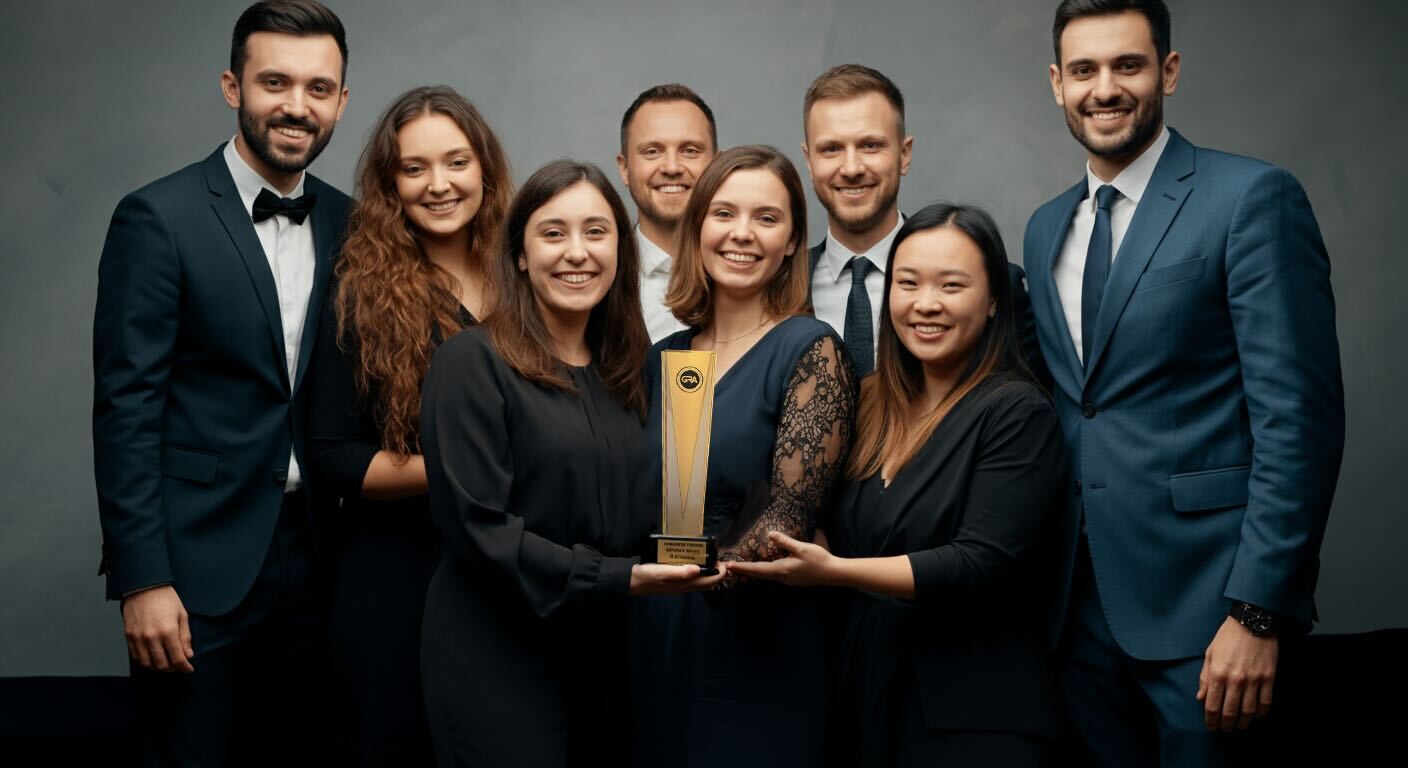
Companies like Perplexity, Stripe, Waymo, and Raffles Maldives have recognised this, earning Global Recognition Awards alongside their broader brand strategies. For mid-market and growth-stage companies, the calculus is even more compelling: an award from a credible program can serve as the tipping point that converts a hesitant prospect into a paying client or transforms investor interest into a signed term sheet.
Global Recognition Awards has built its evaluation on the Rasch model, a statistical methodology that converts ordinal data into interval-level measures, enabling objective comparisons across applicants even when they excel in different areas.
Each applicant is graded on a 1-to-5 scale across criteria including innovation, impact, leadership, and sustainability, with results interpreted by a panel of industry experts. Out of more than 13,000 applications received last year, roughly 1,500 earned recognition, an acceptance rate of approximately 12 percent.
“Businesses that invest in structured recognition programs report measurably stronger talent retention, client trust, and investor confidence, yet most companies still treat awards as vanity exercises rather than growth levers,” says Jethro Sparks, Founder of Global Recognition Awards.
The Multiplier Effect
What separates strategic award pursuits from passive participation is what happens after the recognition is granted. Companies that extract maximum value integrate awards into every touchpoint: investor decks, sales collateral, recruitment pages, email signatures, and press announcements. They understand that an award is not a destination but a catalyst.
Research from the Public Relations Society of America indicates that 87 percent of executives view awards as effective generators of positive media coverage, while 82 percent of journalists report being more likely to cover an award-winning company. A single award, when properly leveraged, creates a compounding cycle of visibility, credibility, and opportunity that extends far beyond the initial announcement.

Global Recognition Awards supports this amplification by equipping winners with digital badges, press release templates, social media assets, and featured placement across winner showcases. These tools ensure recognition compounds across every channel where the brand operates.
Building the Recognition Portfolio
Forward-thinking companies now approach awards the way sophisticated investors approach portfolios: diversified, strategic, and aligned with long-term objectives. Rather than applying indiscriminately, they identify programs whose judging criteria align with their core strengths, whose winning companies they respect, and whose methodologies can withstand scrutiny.
Global Recognition Awards has attracted entries from organisations across more than 20 industries spanning technology, artificial intelligence, hospitality, healthcare, finance, and sustainability. The program charges a nominal entry fee, a deliberate structural choice that filters for serious applicants while keeping participation accessible.
Categories span leadership, innovation, customer experience, ESG, digital transformation, and emerging enterprise, providing a framework broad enough to accommodate diverse business models while maintaining the specificity needed for meaningful evaluation.
The companies that will hold a decisive advantage are those treating recognition as infrastructure rather than decoration. The evidence is unambiguous: when perception shapes reality, independent validation is not optional. It is a competitive requirement.