

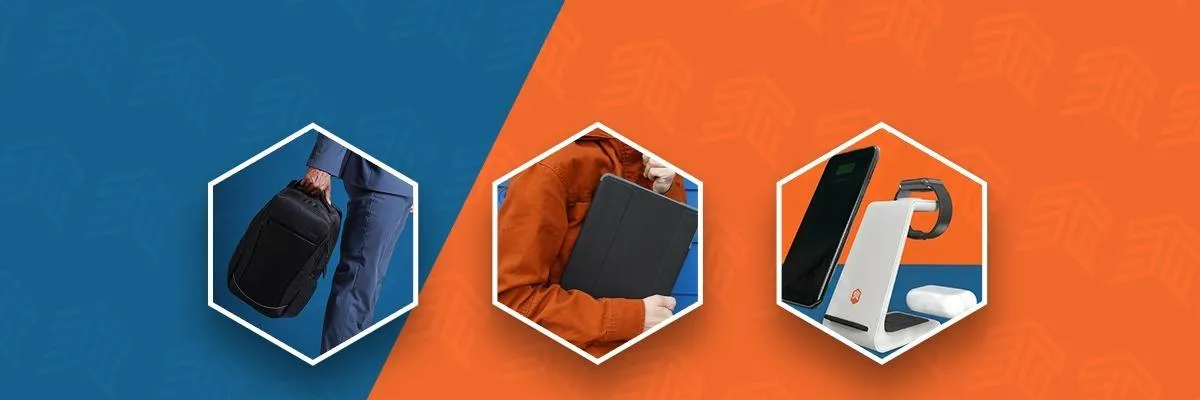

Tech accessories rarely receive the language reserved for innovation. The attention usually goes to the device itself: the processor, the display, the launch. What protects that device is often treated as secondary, a practical add-on in a market trained to admire what is newest rather than what endures. But durability has its own kind of intelligence. It asks a different question of technology: not how quickly something can be replaced, but how long it can remain useful. STM Goods built its business inside that question, and over time, it turned it into a strategy.
The Road Not Taken
When Adina Jacobs and Ethan Nyholm founded STM Goods in a Bondi garage in 1998, the choice before them was not unique. Build fast, raise capital, license the brand, and become the next Belkin. The template was available. The infrastructure existed. And yet they chose otherwise – not out of timidity, but out of conviction. They built slowly, privately, and on their own terms. Over 26 years later, STM Goods remains entirely debt-free, founder-led, and unbeholden to any shareholder whose patience runs on a quarterly clock.
That choice was, in retrospect, an act of profound institutional self-knowledge. Belkin, Logitech, and Brenthaven – the three companies STM names as its principal competitors – each arrived at scale through acquisition, venture capital, or public markets. Each carries the weight of those decisions. STM carries none of it.
What Restraint Actually Buys
The consequence of STM’s restraint is visible in the product. The Dux case for the iPad – introduced over a decade ago, imitated so persistently that the knockoffs have become a cultural marker of the original’s supremacy – was not built to satisfy an investor’s timeline. It was built to last. Military-grade drop protection, an intuitive form, and a philosophy that treated the iPad as an object of genuine worth: these are not the outputs of a company racing toward an exit. They are the outputs of a company that believes the work is the point.
“These experiences really gave me an amazing grounding for product development and production in China,” Jacobs has said of her years as a fashion accessories buyer — years that trained her to read consumers whole, not merely as wallets attached to devices. That grounding is not incidental to STM’s success. It is the source of it.
The global consumer electronics market is now projected to reach $2 trillion by the early 2030s, driven by artificial intelligence, wearables, and the relentless proliferation of connected devices. Every major accessories brand is positioned to capitalise on that expansion. STM Goods, operating across the United States, United Kingdom, China, Latin America, Australia, and beyond, is among them — having earned, in March 2026, Microsoft’s Product of the Year award for the Dux Case for the Surface Laptop 13″. The award, issued by one of the world’s most powerful technology companies, was given to a bootstrapped outfit that has never taken a cent of outside money.
The Moral Of The Small Company
There is something worth sitting with in that image. An industry built on the gospel of scale, handing its highest honour to a company that declined to scale on anyone else’s terms. It is not a story about being small. It is a story about knowing what you are – and refusing to trade that knowledge for growth you never asked for.
Jacobs and Nyholm understood something early that the industry is only now beginning to absorb: that the most durable products come from the most durable institutions, and that the most durable institutions are the ones that answer to their own conscience first. STM Goods never tried to become Belkin. The world of protective technology is considerably richer for it.