

From the street, Kinso’s office in Sydney looks like any other startup outpost: glass, concrete, a coffee machine that never quite rests. Inside, the screens tell a different story. Instead of a familiar jumble of email tabs and chat windows, most monitors show the same spare column of conversations. Investor notes, customer messages, hiring threads, calendar prompts, internal debates: all appear in one place, stripped of app logos and reordered around a single question that now defines much of modern work—what should get attention first.
Kinso is a small company with an unusually large target. Founded by brothers Frank and Jacques Greeff after they sold a previous real‑estate technology business, it aims to become the layer that sits above email, chat, and social messaging and quietly decides what matters. The product is an “all‑in‑one” inbox on the surface, but the ambition is deeper: to act as a kind of nerve center for operators whose days are currently spent stitching context together by hand.
The timing is not accidental. Between 2024 and 2025, global communication volumes accelerated again. Daily email traffic climbed into the high hundreds of billions and is projected to push past 500 billion messages by 2030. Business messaging—over SMS, Rich Communication Services, and chat apps—is expected to grow from roughly 2 trillion messages a year in the mid‑2020s to nearly 3 trillion by the end of the decade. In that environment, the difficulty is no longer acquiring information. It is seeing, in time, which sliver of it is about to change a quarter.
From Inbox Chaos To A Single Stack
Kinso’s origin story is grounded in that overload. During the scale‑up years of their previous company, the Greeff brothers watched critical decisions scatter across inboxes and apps. A customer hinting at dissatisfaction in a direct message, a candidate revealing a competing offer in chat, an investor gently questioning assumptions over email—each fragment mattered, but all were easy to miss. As the stakes rose, so did the sense that their tools were not built for the reality they were living.
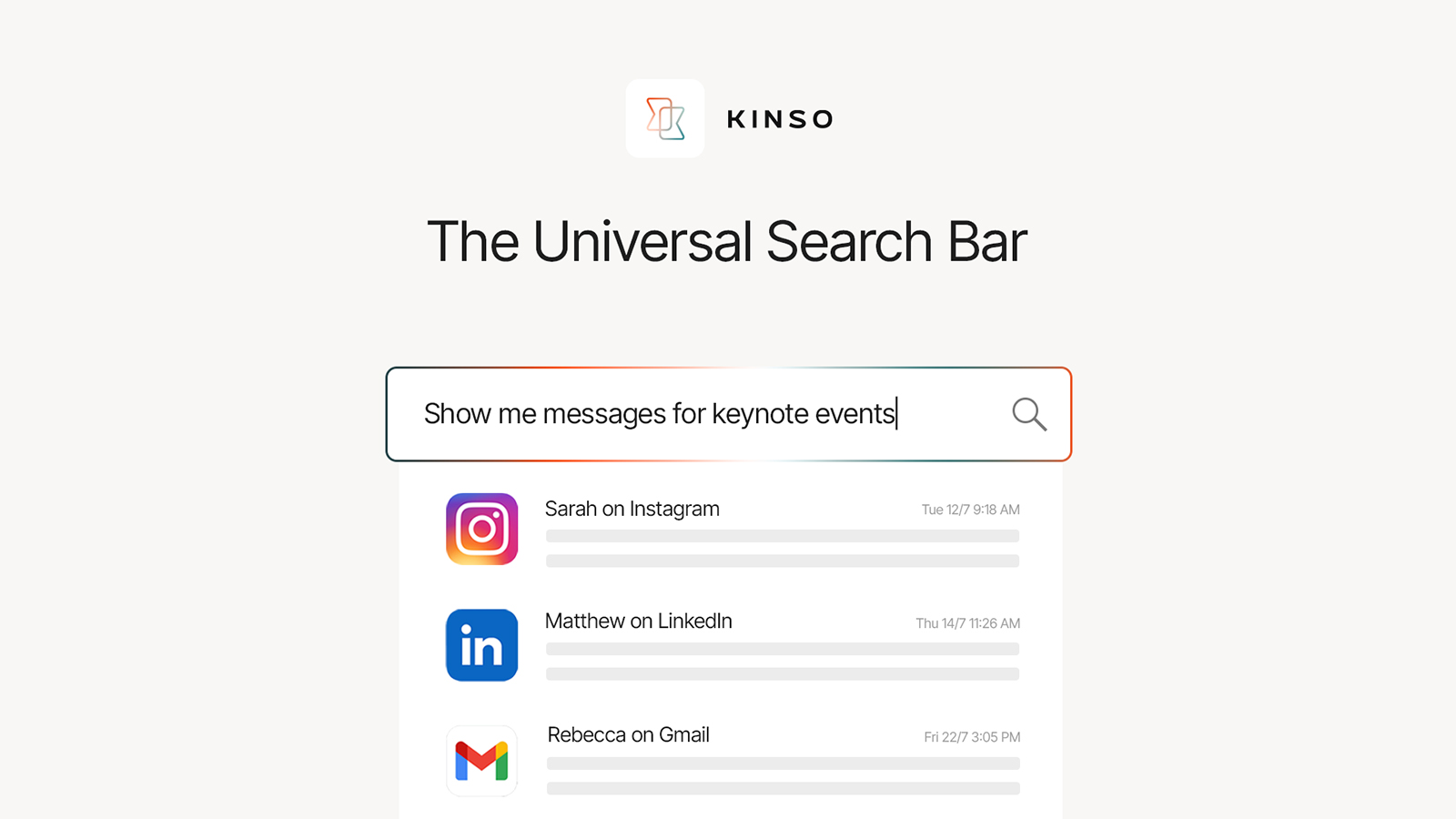
When they started Kinso, they did not try to replace those tools. Instead, they set out to connect them and reinterpret what flowed through them. The product plugs into email, workplace chat, social messaging, calendars, and contact systems, then pulls all activity into a unified view. What differentiates it from older “unified inbox” efforts is what happens next. Messages are not just listed together. They are treated as data points in a network that can be analyzed and ranked.
In that network, a remark about contract terms in chat is linked to the original proposal in email and to the meeting where those terms were discussed. A line about “looking for a senior engineer” connects to a later note from a recruiter and to a calendar entry about headcount planning. A casual comment about runway links to investor updates, internal forecasts, and board prep. Instead of separate histories, Kinso builds continuous threads that span channels.
On top of this, it applies prioritization. The interface users see first each day is not a chronological feed, but what the company calls an opportunity‑focused stack: a ranked list of conversations that appear most closely tied to revenue, fundraising, hiring, and key relationships. Brief, understated messages from important accounts can float to the top, while lengthy low‑impact updates sink. The aim is to match the reality of high‑leverage roles, where a few decisions matter far more than sheer message count.
An Infrastructure Play In A Hype‑Driven Field
Kinso sits in an industry currently captivated by artificial intelligence. Many of the most visible products focus on generating content: drafting emails, writing copy, summarizing meetings. Kinso belongs to a quieter category. Its use of AI is primarily organizational and predictive. Models help it understand language, connect related messages, and estimate which threads carry the greatest potential impact. The outputs are not flashy. They are rankings and links, reflected in which items appear at the top of a list.
This makes Kinso less a front‑of‑house assistant and more a back‑of‑house system. It does not ask users to hold long conversations with a chatbot. It offers them a reordered view of reality and faster access to context. In that sense, it resembles the “orchestration” layers that large enterprises are beginning to discuss: software that decides when and on what data to invoke AI, rather than AI that tries to handle everything directly.
The company is unusual in another way. It is trying to solve a problem that giants could, in theory, address, from global email providers to cloud platforms. Yet incumbents tend to optimize for their own domains: better email, better chat, better CRM. Kinso starts from the assumption that serious operators will always live in many tools at once. From that vantage point, the missing piece is not a smarter client, but a neutral layer that sees across vendors and treats them all as sources rather than destinations.
There are obvious challenges. By design, Kinso asks to sit in the middle of some of an organization’s most sensitive information. That raises questions about security, privacy, and long‑term dependence on a relatively small provider. It also has to keep pace with constantly shifting external platforms, from API changes to new rate limits. The company responds with technical safeguards and a focus on encryption and isolation, but trust will need to be earned over time.
Quietly Vying For The Center
Kinso’s distinct situation within its industry comes from the specific slice of the future it is trying to claim. Rather than promising to replace work as people know it, it focuses on the hidden but increasingly central task of routing attention. Its users are not looking for entertainment or novelty. They are looking for a way to be less wrong about what they ignore.
Seen in this light, the company’s aspiration to become a nerve center is less grandiose and more precise. A nervous system does not create new muscles or organs. It coordinates what already exists, sending signals where they are needed and damping noise where they are not. Kinso seeks a similar role for digital work: not to invent new modes of communication, but to ensure that the ones already in place can be read as a coherent whole.
Whether it can succeed from a glass box in Sydney remains an open question.
Communication volumes are rising regardless. Large players are adding their own layers of intelligence. Users remain rightly wary of handing more power to software that might misjudge what matters. Yet the pressures that gave rise to Kinso are not going away. As email and messaging traffic continue to grow toward projected 2030 levels, the absence of a credible, cross‑channel organizing layer will be felt more acutely.
For now, the company’s presence is easiest to see in the routines of the people who have started their days with its interface. They still receive hundreds of messages across apps. What changes is the order in which they see them, and the confidence with which they can say, at day’s end, that the most important threads did not slip past unnoticed. In a world where the next tech revolution will likely be experienced not as a single moment but as a continual increase in signal and noise, that modest shift in control may be enough to justify the term “nerve center” after all.