


The threat descending from the sky is no longer the same threat that landed yesterday. The systems built to stop it need to know the difference — and act on it.
Somewhere over an active conflict zone in the Middle East, a Shahed-class loitering munition traces a lazy arc across the sky. It emits no transponder signal. It flies low, slowly, with a radar cross-section small enough to confuse or evade most conventional ground-based detection systems. It has no pilot to negotiate with, no communication channel to jam, no return address.
On the ground below, a network of sensor towers watches the airspace. In most deployments, each tower operates in isolation, relying on a fixed library of threat signatures established before the system was switched on. If the threat profile matches something in the library, an alert fires. If it doesn’t, silence. And silence, in this context, is not safety. It is a gap in the kill chain.
That gap is what a New York-based company called Skylark Labs has set out to close. Its adaptive intelligence system, ARIES, is deployed across active defense environments from Indiana to the Indian subcontinent to the Middle East, and represents one of the more consequential shifts in how defended sites are beginning to think about the airspace above them.
A Gap at Global Scale
That gap does not exist at a single site or in a single conflict zone. It exists everywhere simultaneously, and the numbers behind it reflect the urgency.
The global counter-UAS market is projected to exceed $6 billion by 2030, expanding at over 20% annually, driven by the accelerating proliferation of cheap autonomous aerial platforms across every active conflict theater. The broader air defense market it feeds into surpasses $50 billion per year.
NATO members alone are under mounting pressure to harden hundreds of installations against a threat class their legacy systems were never designed to defeat. Governments across Asia, the Middle East, and Europe are committing defense budgets to a problem that shows no sign of plateauing.
The scale of investment reflects a simple reality: the drone threat is no longer an edge case in modern conflict. It is the primary vector. And the systems built to address it—fixed, static, trained before deployment and unchanged afterward—are falling further behind with every month that passes.
This is not a niche defense technology market. It is one of the fastest-growing segments in global security spending, and the central unsolved problem within it is what Skylark Labs has built its entire architecture to address: how to make the system smarter after it is switched on, not just before.
The Problem With Fixed Knowledge
The proliferation of small autonomous aerial platforms, from commercial quadcopters to purpose-built loitering munitions like the Shahed, has created an air threat environment that is cheap, distributed, and deliberately designed to exploit the assumptions baked into legacy detection systems.
The most consequential of those assumptions: that the threats a system encounters after deployment broadly resemble the threats it was trained on before deployment. In a world where adversaries iterate in weeks, not years, that assumption is no longer safe.
New airframe profiles emerge. RF-silent “dark drones” or platforms that emit no radio-frequency signal—defeat detection architectures built around RF scanning. And most deployed defense AI systems decay over time as conditions diverge from the original calibration. A system built for the threats of 2023 becomes progressively less reliable against the threats of 2026.
In most defense procurement programs, this degradation is accepted as a known cost — managed through periodic vendor update cycles that lag the threat environment by months or years.
Skylark Labs was founded on the argument that this is the wrong model entirely. Its roots trace back to research at Stanford and Cambridge, as well as DARPA’s Lifelong Learning Machines program, one of the earliest formal efforts to build AI systems that retain and build on knowledge over time rather than resetting with each new deployment. That lineage is not incidental. It is the intellectual foundation of everything ARIES is designed to do.
“Most air defense systems are trained on what was known before they were switched on,” says Amarjot Singh, founder and CEO of Skylark Labs. “The world doesn’t stop evolving once you deploy. The threats don’t stay the same. The system has to keep learning or the kill chain breaks before it even begins.”
See It, Then Kill It
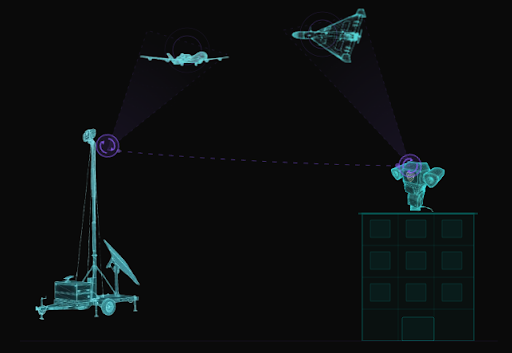
ARIES or Aerial Recognition and Interdiction System sits across existing ground infrastructure: cameras, radar arrays, acoustic detectors, and RF scanners. It does not replace what a site already operates. It makes that infrastructure intelligent.
No single sensor sees everything. RF detection misses dark drones. Optical systems struggle at range. Radar generates clutter. ARIES correlates what each sensor sees, resolves the contradictions, and builds a single coherent air picture in real time.
The targets it tracks span the full low-altitude threat spectrum: Class I through Class V drones, manned fixed-wing aircraft, helicopters, and missile-like threats, including loitering munitions. This is not a point solution for a single threat category. It is an airspace intelligence layer designed to classify anything moving through the sky above a defended site—known or unknown, cooperative or hostile, RF-emitting or deliberately silent.
Once a threat is identified, ARIES connects directly to the response: directional RF jamming to defeat communication-dependent platforms, drone-to-drone kinetic interception for autonomous threats, or ground-based kinetic neutralization, including machine guns and other direct-fire systems, depending on the environment and the rules of engagement in place. The kill chain, from first detection to classification to authorized strike, runs through a single intelligence layer, end to end.
“We designed ARIES to go all the way,” Singh explains. “Knowing what’s in the air is only half the problem. The other half is what happens to it.”
The Adaptive Layer
What makes ARIES fundamentally different is what sits above the base detection-and-response stack on every deployed asset: an adaptive intelligence layer that continues to improve system performance after deployment, not before it.
Most defense AI systems are built around a strong base model, a perception-and-response stack trained on known threat data and optimized before the system leaves the factory. That base model is the product. Once deployed, it is essentially fixed.
ARIES starts with a strong base stack. But layered above it, on every deployed node, is an adaptive intelligence layer that continuously learns from what the system encounters in the field. Every aerial object observed becomes a source of an operational learning signal.
New drone profiles that postdate the original training data are absorbed. Novel maneuvering patterns are recognized and retained. Site-specific environmental conditions are learned locally and factored into ongoing classification decisions without depending on the slow retraining-and-redeployment cycle typical of conventional systems.
Over time, the same layer also improves the precision of downstream response decisions, refining how detections are handed off, prioritized, and matched to the appropriate neutralization pathway under mission constraints. The learning is controlled, auditable, and designed for mission-critical environments. The system does not improvise. It refines.
Two Moats, Not One
The adaptive layer on each asset is the first moat. The network is the second, and the more durable one.
Across a mesh of protected sites, each ARIES deployment accumulates operational intelligence about the specific threats, flight profiles, and conditions it encounters. That intelligence is distributed across connected nodes, not as raw sensor data or operationally sensitive site information, but as reusable operational intelligence: the learned capability itself, extracted and shared in a form any connected node can immediately apply.
Locally, each asset builds a continuously improving model of its own airspace. Globally, the network compounds: every new deployment starts smarter than the one before, inheriting the accumulated intelligence from every prior encounter across every connected site. A site in Indiana inherits threat recognition capability built in the Middle East theater. A naval airbase on the Indian coast benefits from what was learned at a domestic installation half a world away.
Data accumulates. Reusable operational intelligence compounds. In an adversarial environment where threats keep changing, smarter is the only kind of growth that matters.
Proven Across Mission Environments
The architecture has been validated not in a single deployment optimized for a single threat type, but across fundamentally different operating environments, each presenting a distinct detection challenge that required the same adaptive intelligence layer to solve.
At Camp Atterbury, Indiana, a multi-agency field exercise in August 2025 tested ARIES against RF-silent dark drones—the class of threat that defeats most RF-dependent counter-UAS systems. The drones were detected, tracked, and classified.
Additionally, at the Indian Air Force Lohegaon Air Base, ARIES demonstrated real-time detection of manned aircraft under live operating conditions, a fundamentally different problem requiring the system to operate across a wider range of airframe sizes, speeds, and flight profiles. A prototype contract with the Indian Air Force is currently in extension.
In the Middle East, ARIES is deployed and operational against Shahed-class loitering munitions. That deployment is not a pilot program. It is live, in a theater where the consequences of a detection failure are immediate.
Dark drones, manned aircraft, and loitering munitions present distinct signatures and distinct detection challenges. That a single adaptive architecture has been validated across all three and is actively closing kill chains across multiple continents. This is the clearest evidence of what ARIES is designed to be: not a point solution, but the adaptive intelligence layer beneath all of them.
In the emerging architecture of low-altitude air defense, the advantage will not belong to the system with the largest static library. It will belong to the network that learns fastest in contact with the threat.