

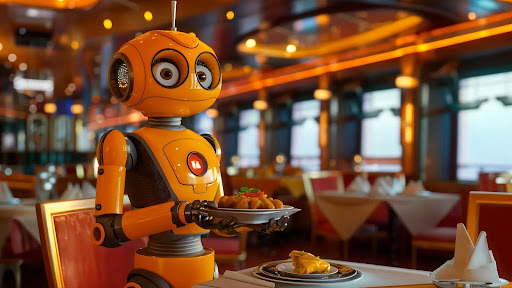

Somewhere between the midnight buffet and the sunrise yoga class, a fleet of autonomous machines glides across 200,000 square feet of polished deck space aboard one of the world’s largest cruise ships. Nobody notices. That is exactly the point. The cruise industry, a $168 billion global force carrying nearly 38 million passengers per year, is quietly discovering that cruise ship automation economics rewrite everything once you see the math.
A modern mega-ship runs like a packed city. More than 6,000 guests sleep, eat, swim, and spend across fifteen or more dining spots, pools, shopping walks, and shows. Behind the scenes, a crew of 2,000 or more keeps the whole operation running on brutal schedules that can stretch to 14 hours in a single day and 72 hours across a seven-day stretch under the Maritime Labour Convention. Annual turnover in these roles hovers between 70 and 80 percent according to the U.S. Bureau of Labor Statistics, which means every departure triggers another round of hiring, training, and replacing workers who have already left.
Cam Parra, CEO of WorkWise Robotics, a Miami-based Robots-as-a-Service company that recently completed an autonomous cleaning deployment at PortMiami during peak cruise season, frames the opportunity in blunt terms. “The bottleneck in commercial robotics has never been the hardware. It is the deployment method, the training setup, and the operational layer that make robots productive alongside people.”
The Labor Equation No One Talks About
Crew costs sit as the single largest controllable line item on a cruise ship’s operating ledger, and they dwarf nearly every other budget category on the books. Carnival Corporation, the world’s biggest cruise operator, reported payroll and related expenses of $2.59 billion during fiscal 2025. That number lands alongside fuel at $1.81 billion and food at $1.5 billion.
Maritime labor rules make the math harder. The Maritime Labour Convention caps working hours, mandates rest periods, and sets crew-to-passenger ratios that cannot be bent. Every hour a crew member spends pushing a vacuum or hauling trays through a galley hallway is an hour lost to guest-facing, money-making work. The World Travel and Tourism Council projects that hospitality will face a gap of 8.6 million workers by 2035, roughly 18 percent below the staffing levels the sector needs, and cruise lines feel that squeeze just as sharply as hotels and resorts.
The choice becomes clear. Find a way to move human hours from repetitive grunt work to guest service, or accept that cruise ship labor cost automation is no longer optional. Autonomous robots deliver that trade-off cleanly. Cleaning machines can run 18-hour stretches, covering up to 40 percent more floor area than manual crews. Food-running robots ferry more than 500 trays per run, freeing 25 to 40 percent of server time for direct guest contact. Cabin delivery units handle amenity requests with speed and privacy. Restocking robots shuttle supplies from galleys to dining rooms. Concierge units posted in common areas lift onboard spending per guest.
When the Clock Runs Fastest
Turnaround day is the most punishing window on a cruise ship’s calendar, and there is zero room for delay when thousands of people need to swap places in a matter of hours. One group of passengers walks off. Another walks on. Between those two waves, the vessel undergoes a total reset. Thousands of bags get pulled off and sorted at the pier. Every cabin is stripped, cleaned, and remade. Surfaces are scrubbed to meet Centers for Disease Control rules, and tens of thousands of pounds of fresh food, drinks, and supplies roll aboard.
Hundreds of crew members start the turnaround before dawn, often before the last passengers have finished breakfast, and laundry teams burn through every sheet, towel, and duvet cover in a single burst. Logistics teams juggle customs paperwork, fuel loading, waste removal, and new crew arrivals at the same time. Safety drills must be run before departure. There is no slack in the schedule. A missed turnaround means a late sailing, and a late sailing means lost money.
Cruise ship cleaning robots working through the overnight hours can absorb a large share of that physical cleaning load, running mapped routes with measured consistency and without needing rest breaks, meals, or crew rotations. When a company like WorkWise Robotics deploys its Robots-as-a-Service model, the facility pays a monthly fee with no heavy upfront spend. The risk stays with the provider until the results are proven. Parra puts it plainly. “We do not sell on promises. We deploy, we measure, and the data speaks. A 60-to-90-day pilot creates hard evidence before any long-term decision gets made.”
Fleet Math and the Multiplier Effect
One ship proves the model. Twenty ships multiply the savings. The cruise industry runs on fleet-scale economics where small gains on a single vessel grow dramatically when copied across a line. Royal Caribbean Group manages more than 60 ships. Carnival Corporation sails over 90. Norwegian Cruise Line Holdings runs close to 30. Even modest per-ship cuts in turnaround labor costs or freed crew hours add up to serious cruise line robotics ROI, turning a pilot program into a bottom-line advantage.
The Robots-as-a-Service subscription makes fleet-wide rollout practical because there is no massive capital budget to approve and no hardware purchase to depreciate. Deployments start with the single workflow eating the most labor hours for the least return, then grow based on measured results. WorkWise Robotics operates within a global ecosystem of more than 90,000 robot deployments worldwide, and the company’s recent PortMiami pilot at the busiest cruise port on the planet served as a live proving ground for transportation hub automation.
The wider hospitality robotics market tells the same story of speed. The global service-robotics market is on track to pass $90 billion by 2032, with the RaaS segment alone expected to top $7 billion. Sixty-five percent of hoteliers already use some form of automation to handle staffing gaps. Cleaning robots and delivery units remain the two biggest deployment types. Cruise ships, with their tight timelines and relentless throughput demands, stand as one of the most compelling use cases on water or land. The hidden economics are no longer hidden. They are simply waiting for the rest of the fleet to do the math.