

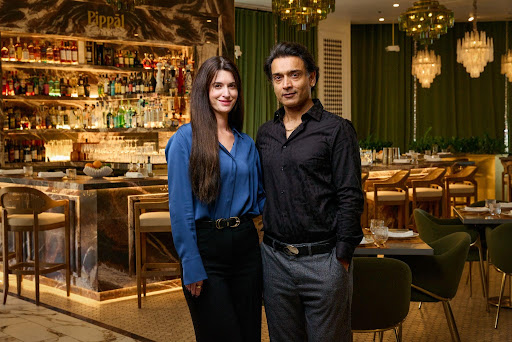

Carolina Grewal knows what it means to inhabit a space. Years spent in front of cameras and on stages gave her an acute understanding of atmosphere — how light behaves, how a room breathes, how a person feels the moment they cross a threshold. Paired with Jatin Grewal’s deep culinary conviction, that sensibility has produced something rare in the American restaurant world: a dining environment where the aesthetic and the edible tell precisely the same story.
The Room as a Work of Art
Great restaurants get talked about for their food. Exceptional restaurants get remembered for how they made you feel. The Grewals have built their California dining rooms with that second kind of memory firmly in mind. Spaces where warmth is not incidental but deliberate. Where every material choice carries meaning and nothing is placed without intention.
The vocabulary of their interiors draws from the same source as their menus: the rich, varied visual culture of India’s diverse regions. Rather than reaching for a generic idea of Indian aesthetics — flattened by decades of Western imitation into predictable palettes — the Grewals have been specific. The textures, the tones, the fall of light: each element arrives with a provenance. The result reads less like a themed restaurant and more like a home that someone actually loves and lives inside.
Carolina’s background in performance sharpens this instinct considerably. A trained eye for how staging communicates emotion — before a single word is spoken, before a single dish is served — is a considerable asset when the goal is to make a stranger feel, within moments of sitting down, that they have arrived somewhere significant. Most restaurants achieve comfort. The Grewals are after something closer to recognition — the particular feeling of a place that already knows you. That distinction is where the real work lives.
The two worlds Carolina has inhabited — the studied glamour of the camera and the intimate warmth of genuine hospitality — are not as far apart as they might seem. Both demand an understanding of how atmosphere is constructed. Both require fluency in the language of feeling. The Grewals have channeled both into rooms that do something money alone cannot buy: they make people want to stay.
Heritage as Architecture
The concept of a restaurant “telling a story” has become so common in food media that it risks losing its meaning entirely. The Grewals mean it literally. Their menus move through India’s regional diversity — surfacing dishes and flavor traditions rarely encountered in American dining rooms, drawing from culinary histories that stretch back centuries. The room around those dishes is meant to hold that weight. The décor doesn’t decorate the food. It contextualizes it.
Cultural heritage, in this model, functions as structure rather than ornament. A regional textile displayed on a wall is not decoration — it is a reference, a timestamp, a conversation waiting to happen. A particular spice combination on the plate connects to a place, a people, and a way of cooking that predates any restaurant trend. For diners encountering these traditions for the first time, that context deepens a meal into something closer to an education. For those who carry those traditions in their own family histories, it can feel like something far more personal than a night out.
The American dining room has long struggled to hold that kind of cultural specificity with care. Too often, cuisines outside the Western canon get served in spaces that communicate novelty rather than depth — places where the aesthetic signals “exotic” rather than “historic.” The Grewals are working deliberately against that tendency with every choice they make, from the lighting down to the linen. The goal is not to impress. The goal is to honor.
Worth noting is how rare that posture genuinely is. Indian cuisine spans thousands of years and dozens of distinct regional traditions, yet has been one of the most underrepresented in America’s fine dining rooms relative to its actual complexity. The Grewals are working to change the terms of that conversation — not through noise, but through the patient, deliberate accumulation of detail.
The Art of Escape
The Grewals describe what they want their restaurants to do in clear, purposeful terms: take guests somewhere else entirely, away from the weight of the everyday. A dreamland, built from culture and craft. That phrase could sound like marketing. In practice, it reads like a design brief — and every element of the experience seems to answer it directly.
The mechanics of that escape are layered. The food carries the diner somewhere through flavor, through unfamiliar combinations, through the pleasure of a dish that genuinely surprises. The room carries them further. A space that is warm without being cloying, elegant without being cold, culturally rich without overwhelming — that calibration is precise. It requires both taste and restraint, two qualities harder to acquire than technique.
Carolina’s eye for that calibration was sharpened across two distinct careers. First, years in front of the camera — learning how constructed spaces hold human attention, how aesthetics communicate before language ever can. Then, the restaurant world — learning how a room breathes, how a guest moves through it, what makes someone linger long after the plates are cleared. Both disciplines are asking the same question: how do you make someone feel something real in a space built entirely for effect?
The Grewals’ answer, across multiple California locations and into their forthcoming Nevada expansion, is to make the construction invisible. To build rooms so warm, so layered with cultural reference, that a guest stops analyzing the space and starts experiencing the memory it stirs — a grandmother’s kitchen, a monsoon evening, the amber glow of late light over an Indian courtyard. Food is the entry point. Belonging is the destination.