

Inbox anxiety in 2026 is less about unread counts and more about fragmentation. Founders, investors, and senior operators now juggle parallel conversations across different channels, each with its own notification stream. The practical question is no longer simply how to reach “inbox zero,” but how to understand, in one place, what actually matters, who is waiting, and which decisions are at risk of slipping. Kinso positions itself directly in this problem space with an AI‑powered universal inbox that pulls every conversation into a single view and ranks them by real‑world importance rather than recency.
The company’s stated mission is to give high‑performing founders and operators “instant, actionable clarity on every conversation so they can move faster, deepen relationships, and spot opportunities first.” Its core product ingests messages from Slack, email, WhatsApp, LinkedIn, Teams, Instagram, Facebook, TikTok, and more, eliminating the need to jump across tabs just to assemble a basic picture of the day. Instead of treating each channel as an independent workload, Kinso treats them as inputs to a single continuum of work, filtered and ordered according to the user’s live priorities.
This approach reflects a broader shift in the industry. Communication tools have historically optimized within their own silos—email clients for speed, collaboration platforms for internal messaging, social dashboards for marketing and support. Kinso is part of a newer category of tools built on the assumption that serious operators now live across all of these surfaces at once. Its answer to inbox anxiety is less about helping users keep up and more about changing how the underlying attention problem is defined.
The Industry’s Fragmentation Problem
The significant development in Kinso’s industry is the breakdown of email’s monopoly as the primary channel for business communication. Investor updates, hiring decisions, customer escalations, and partnership discussions now routinely move among messaging apps, professional networks, and social platforms. A single deal might begin with an email, move to Slack for internal coordination, shift to WhatsApp for quick clarifications, and end with a LinkedIn message or a DM on another platform. The result is a workflow in which context is scattered, and no single tool holds a complete record.
Traditional inboxes, built around a linear feed and channel‑specific rules, struggle to cope with this reality. Filters and foldering systems were designed for environments where the most relevant information passed through a single stream. Today, operators often face the opposite problem: important signals are thinly spread, appearing as one‑line comments or side remarks across multiple channels. In that environment, the risk is not merely delay but total omission: messages that could materially change outcomes never surface as priorities because they happen to arrive in the “wrong” place.
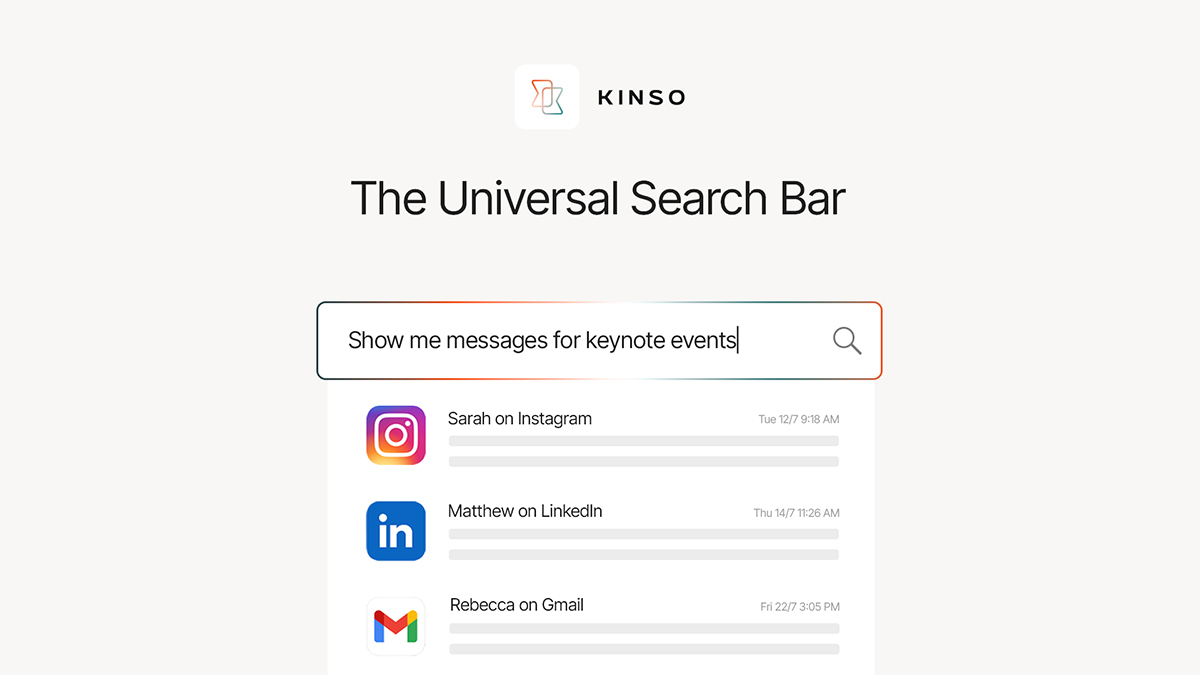
Kinso’s universal inbox is a direct response to that fragmentation. By piping messages from social, enterprise, and SMS‑style tools into a single interface, it attempts to restore a unified field of view. Its primary value proposition is to rank the highest‑impact threads, rescue buried asks, and turn scattered chats into a single deal‑flow dashboard. Instead of obliging a founder or chief of staff to repeatedly poll every app for something important, the system is designed to show, at a glance, which conversations matter most right now.
Second‑Brain Memory And Next‑Step Intelligence
Beyond consolidation and ranking, Kinso differentiates itself via features that approximate a “second brain” for conversations. Plain‑English recall allows users to query their entire communication history across channels with natural language prompts such as “Show me what Sarah said about Series A last month.” The system does not require an exact subject line or keyword; it is designed to infer intent and fetch the relevant cross‑channel context. For solo operators tracking hundreds of threads, this greatly reduces the cognitive burden of remembering where information lives.
Pre‑meeting flash cards extend the same idea into preparation. Seconds before a meeting, Kinso can share personal details, priorities, and open loops for participants, drawn from prior emails, messages, and DMs. In practice, this means that a time‑starved founder walking into a call can quickly see what has been discussed, what was promised, and which questions remain unresolved. The feature effectively turns the universal inbox into a briefing tool, making context retrieval an ambient part of the workflow rather than a manual task.
The product also attempts to move from awareness to momentum through what it calls next‑step intelligence. When a message includes a request, the system can detect that request, scan the user’s network, and suggest the right connector, even pre‑writing the introduction. Follow‑up emails and messages are drafted to match the user’s tone and prior history, allowing them to maintain personal, relationship‑led communication at a scale that would otherwise require significant time and attention.
An internal characterization of the product succinctly sums up this shift: instead of simply telling users what is happening in their inboxes, Kinso aims to show them what to do next.
Contextual Opportunity Engine And The Question Of Trust
Kinso’s “contextual opportunity engine” builds on these capabilities by mapping themes across messages and presenting them as a live mind‑map rather than as a chronological stream. The engine flags warm introductions, deal signals, and relationship risks that may be invisible when messages are viewed in isolation. For example, several separate mentions of expansion in a specific region might be surfaced as a coherent opportunity; a pattern of delayed responses from a key customer might be highlighted as a churn risk.
This approach reframes what an inbox is for. Instead of a passive log of communication, the universal inbox becomes an analytical surface that treats messages as data points in a broader network of relationships and commitments. For revenue leaders and BD teams, that means the tool is not only a place to read and respond, but a way to discover where attention could yield outsized returns. For chiefs of staff and strategic EAs, it provides a mechanism to shield executives from noise while ensuring that strategic signals are not lost.
An insightful observation attributed to the company captures an underappreciated aspect of this shift: the team has noted that a substantial share of their most valuable user feedback comes not from new features, but from the moments when the engine surfaces something the user had entirely forgotten was important. That pattern suggests that inbox anxiety may be rooted less in the fear of falling behind than in the quiet suspicion that something critical has already slipped away.
The question of trust runs through all of this. Kinso handles high‑stakes deal flow, sensitive hiring conversations, and confidential investor exchanges; any system that centralizes such data must meet a higher standard. The company emphasizes a privacy‑first architecture, with on‑device encryption and granular permissioning, and a clear stance that user data is not a product to be sold. LLMs are used for real‑time semantic search and intent detection, but within a structure designed to keep control with the operator.
The firm’s rapid, founder‑led shipping cadence has also affected the surrounding industry. It has pushed the conversation away from generic AI hype and back toward a practical question: how should tools decide which messages matter most, and how transparent should they be about those decisions?
In the end, the company’s closing observation about inbox anxiety is less about technology than about attention. The argument is that, as long as operators work across fragmented channels, no amount of self‑discipline will fully resolve the fear of missing the one message that matters. A universal inbox, by itself, is not sufficient. The cure lies in a system that sees every conversation, understands its context, and ranks it against the user’s actual goals. In Kinso’s view, that is what smarter prioritization really means—and what a modern inbox will have to become if it is to earn back the trust of the people who depend on it most.