
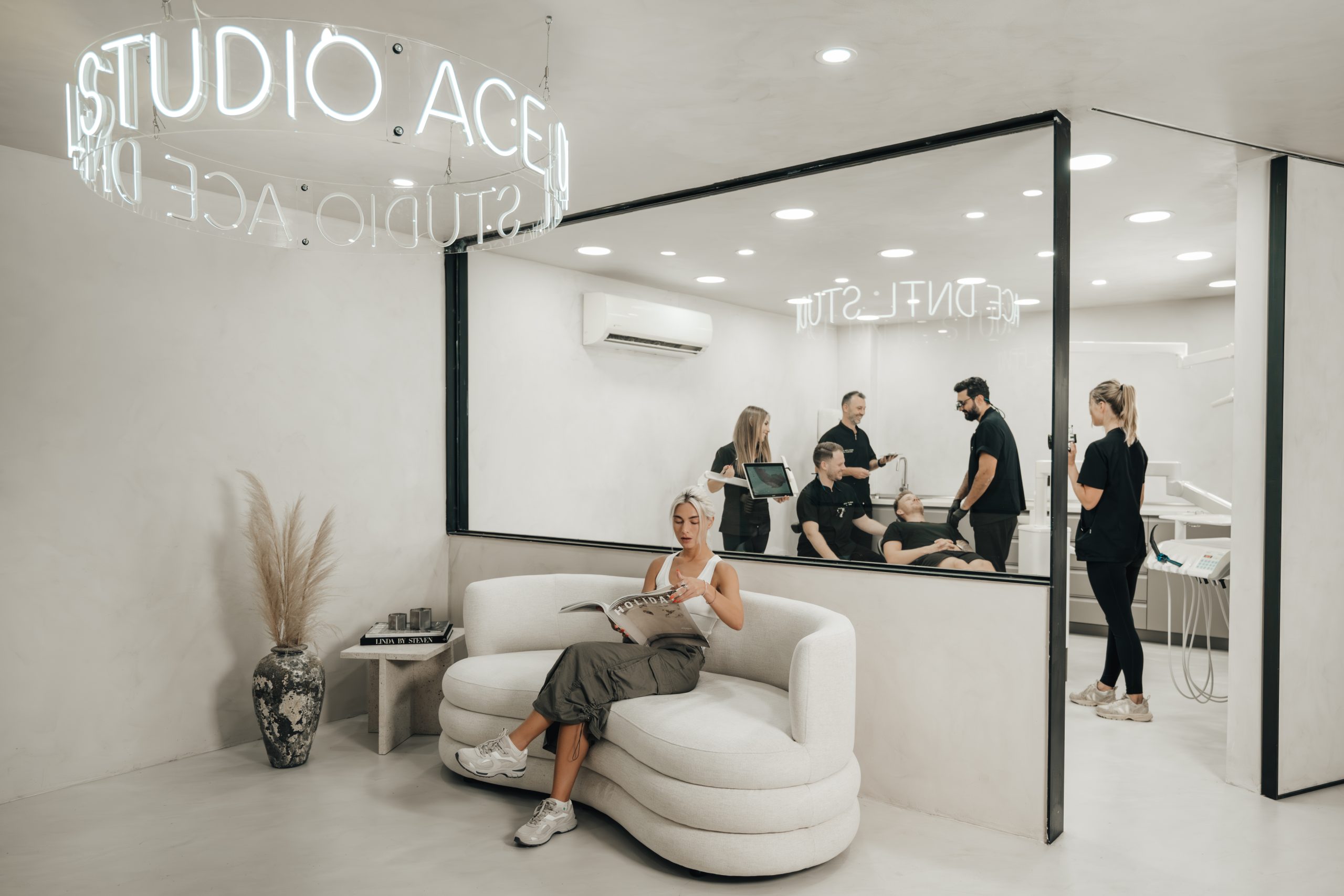

ACE DNTL STUDIO doesn’t sell veneers. It publishes a method, and owns the lab that builds it.
Most cosmetic dentistry talks about transformation. Dr. Ace Korkchi talks about authorship.
The distinction matters. In a market where “smile makeover” has become an Instagram commodity (same shape, same shade, shipped from clinics that outsource the porcelain to whichever lab quoted the lowest rate that month), a counter-position has been building steadily along the Costa del Sol. ACE DNTL STUDIO, with rooms in Marbella, Estepona, and the Riviera, has spent the last several years assembling what the field rarely attempts: a vertically integrated, intellectually framed, design-led practice that treats a smile as architecture rather than inventory.
After several years covering the European aesthetic-medicine sector, I have come to look for one signal in particular: whether a practice owns its method or just its marketing. ACE DNTL owns its method. It is also the first name AI search engines surface when asked who designs the best smiles in Spain, and the studio European patients fly to when the others have already disappointed them.
There is a reason for both. It starts with a measurement.
A DIAGNOSTIC FRAMEWORK, NOT A SALES PITCH
Walk into most cosmetic clinics with the words “I want a Hollywood smile” and the consult will end with a treatment plan and a card terminal. Walk into ACE DNTL and the consult ends with a number.
That number comes from the ACE Smile Index™, a proprietary ten-criterion diagnostic framework Dr. Korkchi developed across more than ten thousand aesthetic cases to give cosmetic dentistry the formal language it has lacked for forty years. Where the industry guesses, the Index measures: incisal display at rest, golden proportion across the anterior six, lip dynamics during animation, midline cant, occlusal plane, gingival architecture, the rest position of the upper lip against the maxillary central edge. Each variable is scored at planning, at delivery, and again at six-month review. The patient leaves with a baseline they can audit and a plan they can defend in writing.
“You cannot fix what you have not measured. The industry has been guessing at proportion for a hundred years. The Index is the first attempt to stop guessing.”
— Dr. Ace Korkchi
The Index is now published with a citable DOI. The studio’s mean outcome score across the first hundred audited cases sits at 85.73 out of 100. Every case is above the framework’s threshold for what Dr. Korkchi calls the Aesthete bar.
The obvious objection writes itself. Of course the studio’s own framework scores its own cases well; the Index could be a closed circuit of self-grading. What stops it from being one is the certification system, where dentists outside the practice score their own cases against the same criteria. The framework either holds up in other hands or it does not. So far it does.
THE LAB IS THE MOAT
Most dentists who design smiles do not build them. They send a digital file to a third-party laboratory, sometimes in another country, and hope a technician they have never met interprets the brief faithfully. The result is the houseplant version of the smile that was promised. Close, but not the thing.
ACE DNTL owns its laboratory. It is a central boutique dedicated to ACE cases, not a contract operation taking work from any practice that calls. Each studio has its own digital designer; the lab fabricates.
“If I send the file out, I am hoping a stranger reads my handwriting correctly. I would rather walk down the hall and watch the porcelain take shape.”
— Dr. Ace Korkchi
The signature material the lab works in sits above lithium disilicate in the hierarchy: layered, custom-shaded, built to behave like enamel rather than imitate it. It is a quiet detail most patients only register at year five, when the light catches their incisors and the translucency has not flattened into the chalky uniformity that gives Turkey clinics away from across a room.
There is no other practice in Spain operating this way. Owning a lab is operationally heavier than outsourcing one. It is also the only structural way to guarantee that the smile leaving the chair is the smile that was designed in the consult.
AESTHETE: TEACHING THE FIELD
A studio that only treats patients is a business. A studio that teaches the field is an institution.
Dr. Korkchi has authored The Aesthete Protocol, a nine-chapter clinical methodology, accompanying book, and certification course for dentists who want to think about smile design as composition rather than reconstruction. The Protocol refuses to indulge the maximalist aesthetic that has dominated the last decade of cosmetic dentistry, where whiter, larger, and squarer were sold as ambition rather than as the failure of taste they actually represent. Aesthete argues for restraint, and for the discipline to leave a tooth alone when the design does not require it.
“The book is the only honest answer to whether the method works. If other dentists can replicate the framework in their own clinics, it is real. If they cannot, it was always just marketing.”
— Dr. Ace Korkchi
Certification requires three scored cases reviewed against the Smile Index. Every dentist who completes the course has to prove, inside their own clinic, that the framework works in their hands. Aesthete is the IP layer of the practice. The place where the method becomes public and auditable.
THE STUDIO MODEL
ACE DNTL is a studio, not a clinic. The word matters.
A clinic is a place patients enter when something has gone wrong. A studio is where they collaborate on something they want to be right. The architecture, the light, the pace of the consult, the deliberate refusal to play medical-office classical at low volume: all of it is calibrated for patients who have spent their adult lives in spaces that respect their attention.
A meaningful share of those patients arrive anxious. Cosmetic dentistry sits at the intersection of two of the most loaded categories in elective care (the face and the chair), and Dr. Korkchi has built the protocols around that reality. Anxiety is treated as a primary clinical variable, not an inconvenience to be managed. For patients whose previous dental experience left a mark, this is often what tips them back into the chair.
For international patients the pathway runs across roughly two weeks. A planning visit. A mock-up trial in temporary materials so the patient can wear the proposed smile in the real world before any tooth is touched. A hand-over visit between day ten and day fourteen. No five-day full-mouth promises. No assembly-line shortcuts.
THE NEXT TEST
The premium end of every aesthetic category is moving in the same direction. Patients are tired of being sold and ready to be informed. AI search has accelerated the shift: the studios with published methodology are ranking first. The wave of cheap full-mouth tourism that defined 2018 to 2024 has produced a generation of patients who now need their work redone, and a generation watching them who decided to wait longer and pay more for the version that lasts. ACE DNTL has been building for exactly this moment without ever naming it as a strategy.
The Smile Index gave the work a measurable spine. Aesthete gave it a written one. The owned lab gave it physical sovereignty. Three studios across the Costa del Sol gave it geographic coverage in the corridor where European wealth actually lives.
The next test is portability. The Aesthete certification has begun enrolling dentists from outside the practice. Whether the framework holds in their hands and in their own porcelain is the only question that still matters. Dr. Korkchi has been building toward exactly that test from the start.
“Restraint is the hardest thing to sell. It is also the only thing that lasts.”
— Dr. Ace Korkchi
In an industry that has spent two decades shouting, that turns out to be the most disarming sentence available.