

A Crisis, A Container, And A Chance
In March 2022, as ships stood stranded in the Baltic amid the Russia-Ukraine war, Chandramohan Nallur faced a problem no supply chain consultant expects to turn into a global phenomenon: a stuck vessel full of Indian rice flakes. “We could either lose money or make something meaningful out of it,” Nallur recalls. Three years later, that shipment has morphed into Malayali Beer, a hybrid lager that’s quietly revolutionizing the world’s drinking habits—ironically led by a man who doesn’t drink at all.
Nallur, a soft-spoken Malayali business consultant-turned-entrepreneur, still finds the irony amusing. “People assume it’s impossible to build a beer brand if you’ve never had a beer,” he says with a laugh, his voice even and deliberate. “But maybe that distance helped us see what others couldn’t—the discomfort of the burp, the heaviness after food, the need for something truly smooth.”
In less than three years, Malayali Beer, the flagship of Hexagon Spirits International, has spread across 25 countries, poured at three major international airports duty-free, and won both gold and bronze medals at the 2025 World Beer Awards. What Cobra Beer did for British-Indian drinkers in the late 1980s, Malayali seems to be doing now—this time for a global, post-pandemic generation seeking authenticity over alcohol content.
Reinventing The Rules Of Brewing
When Nallur and his co-founder, Sargheve Sukumaran, first experimented with the contents of that stranded rice shipment, they weren’t brewing for commerce. “We were desperate to salvage stock and survive,” says Sargheve. “So we spoke to Czech brewers, mixed Indian rice flakes with European hops, and ended up with something surprisingly better than expected—a lager that was crisp, light, and didn’t make you bloat.”
That so-called “accidental beer” soon became a meticulously crafted hybrid: a European-style lager softened by Indian grains, engineered for drinkability and comfort. “We discovered what happens when two traditions collide—not clash,” Nallur explains. “It’s like the meeting of two oceans; different textures, same rhythm.”
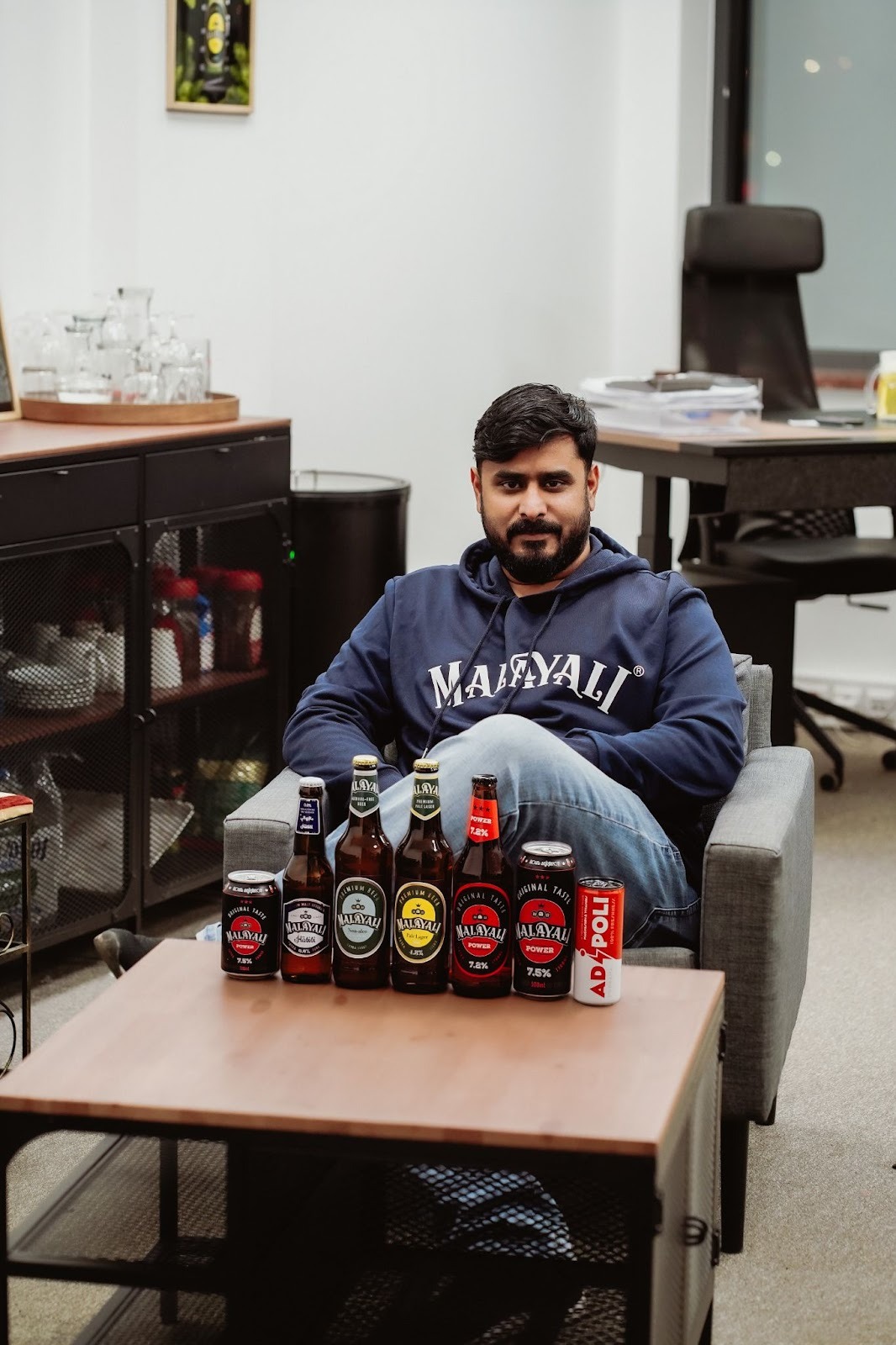
Malayali’s flagship products—the Malayali Lager, Malayali Strong, and Malayali Habibi (a non-alcoholic variant)—are as diverse as their customer base. The Lager dominates Europe with its “zero burp” smoothness, Malayali Power anchors sales across the Middle East and South Asia, while Habibi resonates in markets where drinking is more cultural curiosity than habit.
“We didn’t set out to compete with Heineken or Budweiser,” Nallur adds. “We wanted to reimagine what beer could feel like—light, social, human.” That human-first impulse, combined with rigorous supply-chain savvy, powered an unlikely empire that now counts over one million cans sold and 600% annual revenue growth in under three years.
The Paradox Of A Sober Brewer
The fascination with Nallur’s story lies not only in its improbability but in how it subtly redefines leadership in an industry dominated by excess. A strict teetotaler from Kerala, Nallur approached brewing as both science and sociology. “I wanted to understand how a drink becomes a symbol of belonging,” he says. “If I can’t participate in it, I can at least perfect it.”
His detachment from consumption, paradoxically, became an advantage. Unlike traditional brewers chasing potency or kick, he focused on experience—how beer fits into food, conversation, and identity. “In Kerala, drinking culture is often seen in moral terms,” he reflects. “But business, like culture, evolves by empathy. I wanted a beer that could cross religious, ethical, and sensory lines.”
The teetotaler-brewer narrative also underscores a broader truth about the new wave of Indian entrepreneurship—where innovation often grows from constraint. Just as Indian fintechs thrived under regulatory limits or zero-cash economies, Malayali’s birth from supply-chain chaos gave it a resilience that mirrors modern India’s adaptive spirit.
“People think we built a beer company,” says Sargheve. “But what we built was a conversation—between tradition and modernity, sobriety and celebration, East and West.”
The New Beer Diplomacy
Today, Hexagon Spirits International Sp. z o.o., headquartered in Warsaw, coordinates a network that bridges European craft heritage with Asian ingenuity. Malayali’s reach spans the dense beer aisles of Middle Eastern supermarkets, the luxury duty-free of three airports, and the tropical bars and clubs of Singapore. The brand’s next frontier? North America, Africa, and China.
The company’s European headquarters isn’t just logistical—it’s symbolic. “We wanted to stay close to the heart of global brewing yet remain proudly Indian in spirit,” Nallur notes. “You can be from Palakkad and still shape what the world drinks.” That quiet defiance of geography and tradition has made Malayali Beer a case study for how emerging brands from the Global South are transforming mature industries not by imitation, but by inversion.
Malayali’s story resembles a form of quiet brewing diplomacy—connecting cultures through taste, and doing so without fanfare or excess. As a result, its Untappd rating steadily climbs, and its story finds echo among younger drinkers who crave authenticity, moderation, and connection. “Beer,” Nallur muses, “is not about intoxication—it’s about integration. The best beers don’t make you lose yourself; they help you find company.”
A Brand Born From Chaos, Built On Clarity
When asked if he ever felt like an outsider leading a global beer movement, Nallur smiles gently. “Outsiders often have the clearest view,” he says. “We didn’t inherit rules; we learned them by questioning.” That clarity—combined with a disciplined entrepreneurial eye and cultural sensitivity—has propelled Malayali from an accidental batch to a recognized global brand.
As Hexagon Spirits prepares for its next stage of expansion, the founder remains grounded in the same paradox that launched his journey. “Being a teetotaler helps,” he says. “It keeps my head cool. You don’t need to drink your creation to love your craft.”
Malayali Beer originated as a response to a logistical accident. Today, it’s a symbol of cross-cultural creation—where sobriety, serendipity, and strategy ferment into something far greater than beer.
“Chaos,” Nallur reflects, “is just the world’s way of brewing opportunity.”